Complete Regime Reversal: CPI 3.8%, PPI 6.0%, Trump Rejects Iran Deal

Market Sentiment Overview
The week of May 18 to 22 opens in the wake of the most dramatic single-week regime reversal since the Iran war began on February 28. In five trading days, the market has undergone a complete philosophical reset: from pricing de-escalation, Fed cuts, and Dollar weakness to pricing re-escalation, Fed hikes, and Dollar strength. The catalyst was a double inflation shock (April CPI at 3.8% YoY, highest since May 2023, followed by April PPI at 6.0% YoY, highest since 2022, dramatically above the 4.9% estimate) arriving simultaneously with Trump’s rejection of Iran’s peace proposal as garbage, the ceasefire called unbelievably weak and on massive life support, and the emergence of Iran’s Tehran Toll Booth framework charging $1 to 2 million per ship in yuan or crypto for IRGC-controlled corridor passage through the Strait of Hormuz. The numbers tell the story with unusual precision. DXY went from lower Bollinger Bands at 97.55 to above upper Bollinger Bands at 99.01 (a 146-point weekly gain, now above all three major moving averages for the first time since the war began). EUR/USD went from above upper Bollinger Bands at 1.1785 to below lower Bollinger Bands at 1.1625 (a 160-pip weekly loss). GBP/USD suffered the worst week in months, falling approximately 2% from 1.3631 to 1.3322, erasing the historic 1.3600 triple top breakout in five sessions and pushing the pair below all three major moving averages for the first time since March. Gold lost over 3%. Bitcoin recorded its first weekly ETF outflow since the end of March at -$709.88 million. WTI surged back above $100 as Trump rejected Tehran’s proposal and Aramco’s CEO warned of 100 million barrels of weekly supply loss. The S&P 500 provided the most paradoxical signal: the index reached a new all-time high of 7,501 on Thursday, but the internal breadth was alarming (only 42 stocks making new 52-week highs versus 114 hitting new 52-week lows). Declining stocks outnumbered advancing stocks even as the index itself pushed to a new record. This is the textbook definition of narrow breadth in an overbought market.
Currencies
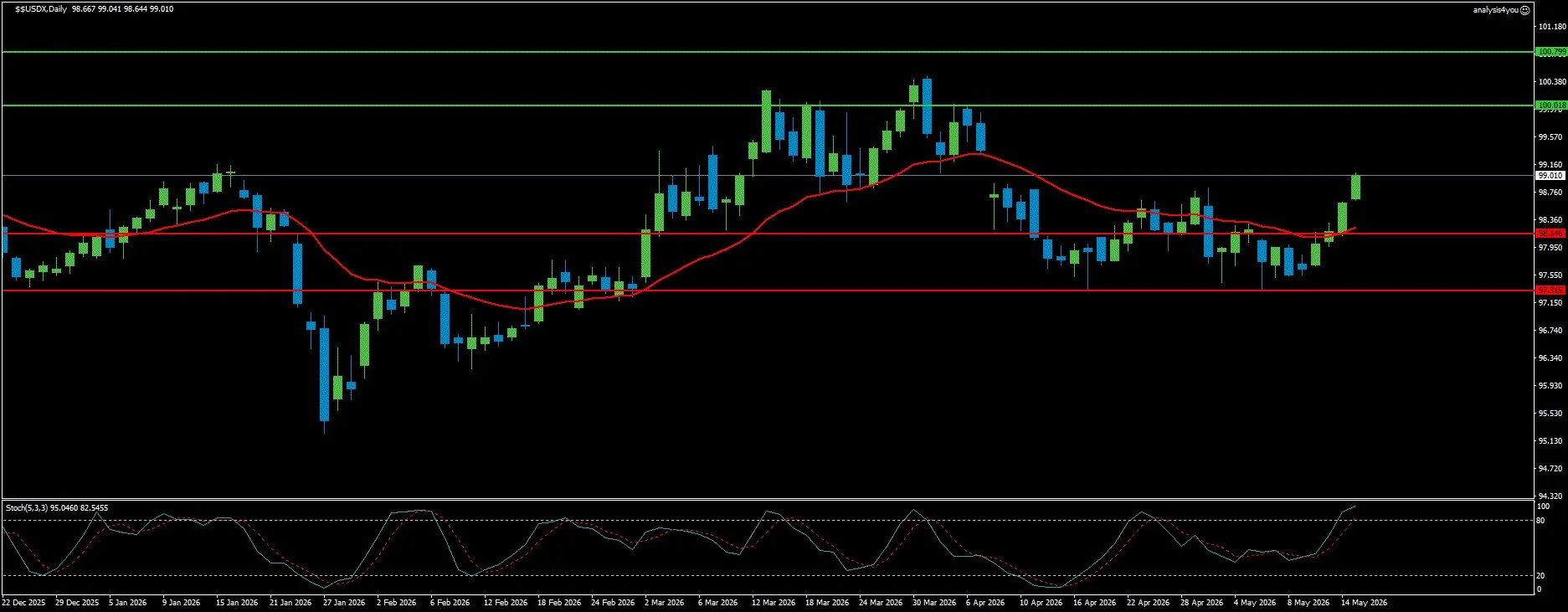
USD Index: Complete Reversal, First Time Above All MAs Since War Began (99.01)
Current Trend: Bullish
Resistance: 100.02 | 100.80
Support: 98.15 | 97.32
The US Dollar has staged its most decisive weekly recovery of the entire Iran war. DXY at 99.01 is now above all three major moving averages (MA 20, MA 50, and MA 200) for the first time since the conflict began. Two consecutive bars above upper Bollinger Bands confirm this is a genuine breakout rather than a temporary spike. The DXY broke the key $99.00 zone (former multiple tops and 50% retracement) with daily studies in full bullish configuration including a strengthening positive momentum and a daily bull-cross. The fundamental shift behind this move is the most significant monetary policy repricing of the war. The double inflation shock (CPI at 3.8% YoY and PPI at 6.0% YoY) has moved the CME FedWatch probability of at least one Fed rate hike by end-2026 to approximately 40 to 50%, up from just 10% two weeks ago. At the heart of the Dollar’s move was a sharp repricing of Fed expectations, from when rate cuts would begin to whether the Fed may eventually need to tighten again. The Fed speaker barrage delivered a consistent hawkish message. Collins said restrictive policy may need to remain in place for some time and acknowledged that another rate hike could become necessary. Kashkari argued the Iran shock and Hormuz closure had materially worsened the inflation environment. The US Dollar may have found its floor. Non-commercial speculative accounts maintained bullish Dollar exposure for an eighth consecutive week per CFTC data. Technically, DXY at 99.01 is in a sharp V-shaped recovery. Above MA 20, MA 50, and MA 200 simultaneously for the first time since the war began. The Stochastic at 95.05/82.55 is deeply overbought in an uptrend with a bullish signal. Resistance at 100.02 is the immediate target. On the downside, 98.15 is first support.
EUR/USD: Below Lower Bollinger Bands, Bearish Structure Confirmed (1.1625)
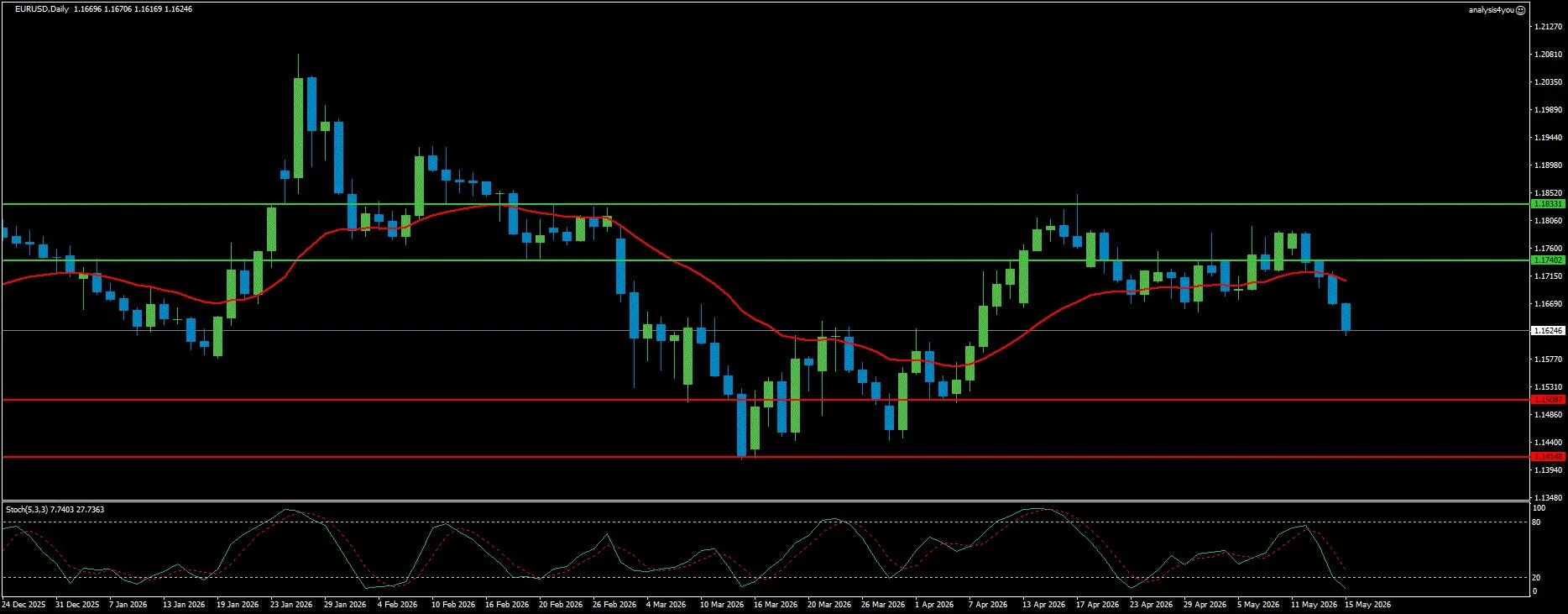
Current Trend: Bearish
Resistance: 1.1740 | 1.1833
Support: 1.1509 | 1.1415
EUR/USD has completed a full bearish reversal from the upper Bollinger Band breakout of two weeks ago to below lower Bollinger Bands this week. At 1.1625, the pair has lost 160 pips in a single week and is now below MA 20 and MA 50 (though still above MA 200 at approximately 1.1682, which provides the structural long-term floor). The EUR/USD pair turned bearish in the daily chart, with all three SMAs overhead and the shorter ones gaining downward traction. Technical indicators are gaining downward momentum below their midlines. The fundamental narrative has deteriorated on both sides simultaneously. On the Dollar side, the double inflation shock drove Fed rate hike expectations to 40 to 50% probability by year-end. On the Euro side, the Eurozone reported Q1 GDP at only 0.1%. Germany’s ZEW Economic Sentiment improved marginally to -10.2 but the current situation deteriorated further to -77.8 from -73.7. Stagflation at the shores of the Old Continent captures the Eurozone’s dilemma: the ECB cannot hike aggressively without risking recession, and cannot cut without risking inflation entrenchment. The week ahead brings FOMC Minutes Wednesday (hawkish outcome would add further EUR selling), UK CPI Wednesday, and flash PMI data Thursday. Technically, EUR/USD is at 1.1625, with two consecutive bars below lower Bollinger Bands. Below MA 20 and MA 50. The Stochastic at 7.74/27.74 is at its most deeply oversold reading of the entire war series. Resistance at 1.1740 is the immediate ceiling. The 200-day SMA near 1.1682 is the most important single level (a weekly close below it would confirm the bearish trend).
GBP/USD: Historic Triple Top Breakout Invalidated, Below All Three MAs (1.3322)
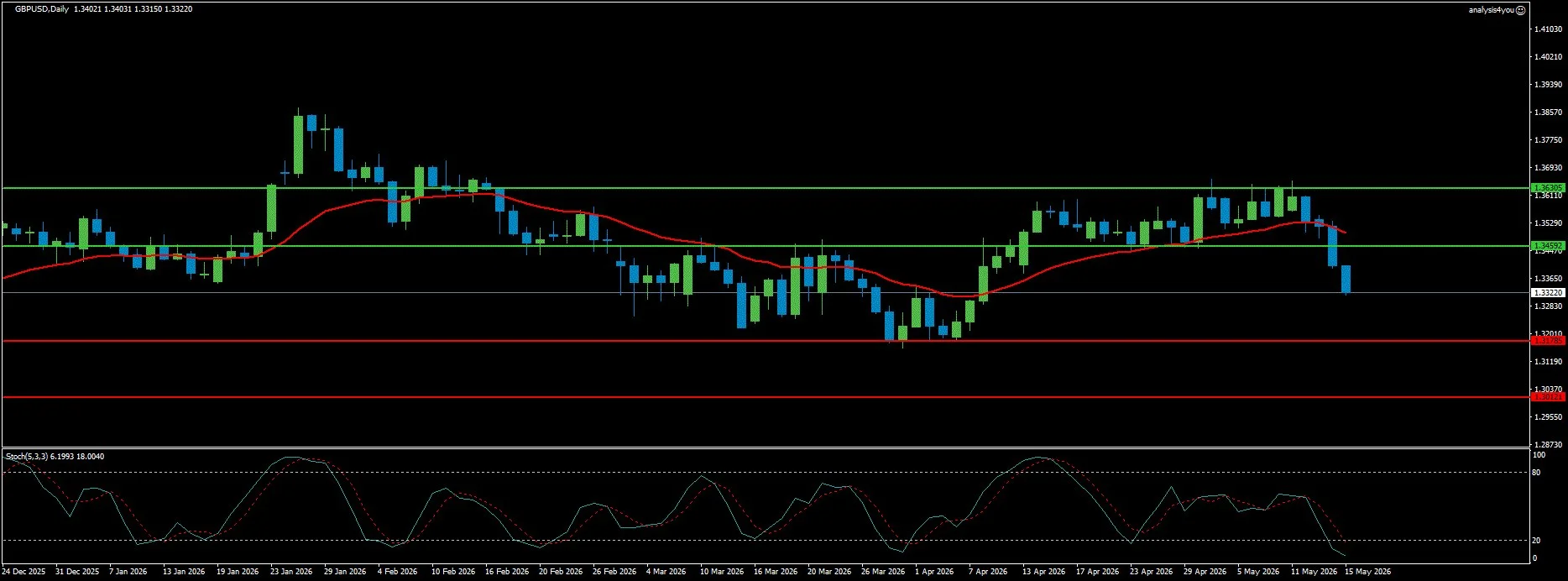
Current Trend: Bearish
Resistance: 1.3459 | 1.3630
Support: 1.3179 | 1.3012
GBP/USD has suffered the most dramatic single-week reversal of any instrument in the entire series. From the historic 1.3600 triple top breakout confirmed just two weeks ago to now at 1.3322 (below MA 20, MA 50, and MA 200 simultaneously, a place it has not traded since early March). The weekly loss of approximately 2% (309 pips) was its worst in several months. The breakdown was driven by a double shock: the external Dollar rally on US CPI and PPI inflation surprises, and the internal UK political crisis that pushed 10-year Gilt yields to 5.14% (a level not seen since the sub-prime crisis) as more than 70 Labour MPs publicly urged PM Starmer to resign after heavy local election losses. GBP/USD lost about 0.7% on Tuesday alone. UK political instability deepened, with the 30-year gilt yield briefly touching 5.81% (its highest level since 1998) amid worries that a leadership transition could mean looser fiscal policy. UK Q1 GDP on Thursday showed expansion at 0.6% in Q1 (better than the 0.2% prior reading) but Sterling failed to attract bids despite this positive growth surprise. The hot US CPI overwhelmed all positive UK domestic signals. The week ahead brings UK employment data Tuesday, UK CPI Wednesday, UK Retail Sales Friday, and flash PMIs Thursday. Technically, GBP/USD is at 1.3322, with two consecutive bars below lower Bollinger Bands. Below MA 20, MA 50, and MA 200 simultaneously. The Stochastic at 6.20/18.04 is the most deeply oversold reading of any instrument across the entire ten-week series. Resistance at 1.3459 is the first meaningful ceiling. On the downside, 1.3179 is the next support.
Stocks
S&P 500: ATH at 7,501 But Bearish Stochastic Flashes Warning (7,394)
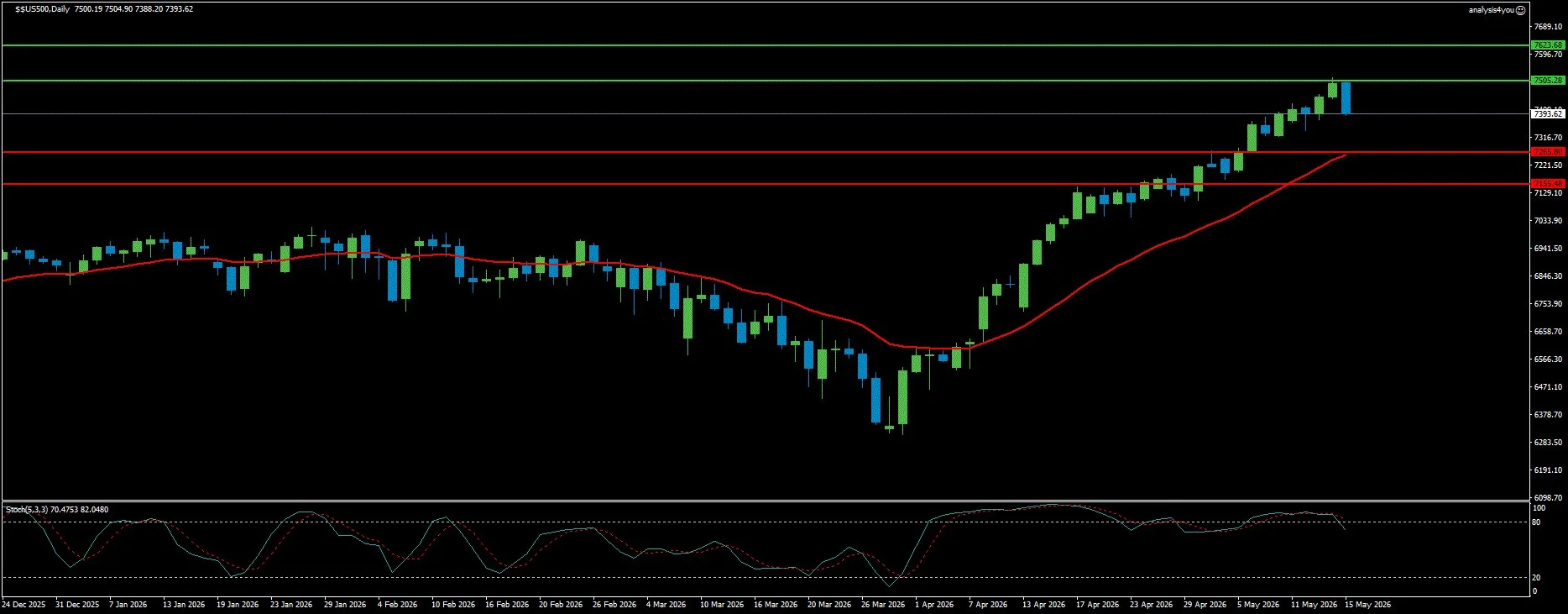
Current Trend: Cautiously Bullish
Resistance: 7,505 | 7,624
Support: 7,266 | 7,155
The S&P 500 reached a historic milestone on Thursday (closing at 7,501, a new all-time high and the fifth new century mark in a single month). The Dow Jones crossed 50,000 for the first time. Since the March 30 war low of 6,316, the S&P has advanced 18.7% (one of the strongest reversals in US stock market history). The catalyst on Thursday was Cisco surging more than 13% after crushing earnings expectations. But the detailed analysis of Thursday’s session revealed the most important warning signal of the entire rally: narrow breadth. On the day the S&P closed at 7,501 (a new all-time high), only 42 stocks made new 52-week highs while 114 stocks hit new 52-week lows. Declining stocks outnumbered advancing stocks. A handful of mega-cap tech and AI names are doing almost all the heavy lifting. The VIX’s reading of 17.26 on Thursday (down 3.4% on the day the S&P hit 7,501) strikes most analysts as dangerously complacent. By Friday morning the VIX was up 9% to 18.83. The 30-year Treasury yield pressing into the 4.97% to 5.03% zone is the structural headwind. The week ahead brings Nvidia’s earnings (the most important single company report of the week). Citi estimates sales near $80 billion above the $78.6 billion consensus. A Nvidia beat would sustain the AI narrative. A miss or disappointing guidance would be the catalyst for the pullback. Technically, the S&P 500 is at 7,394, having pulled back from the 7,501 ATH. The Stochastic at 70.48/82.05 is overbought in a downtrend with a bearish signal (the first bearish Stochastic configuration since the rally began from the March 30 lows). Resistance at 7,505 is the immediate ceiling. On the downside, 7,266 is the first meaningful support.
Commodities
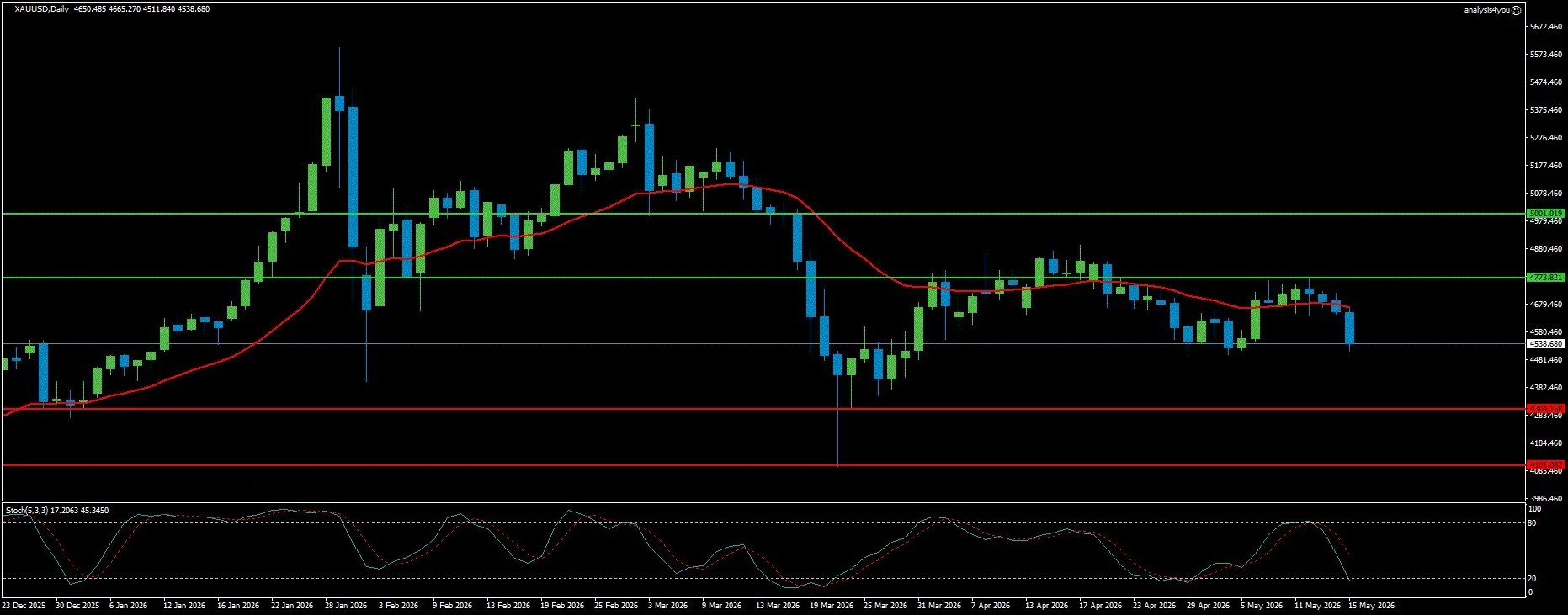
Gold: Triple Headwind, Lower Bollinger Bands, $4,500 Support at Risk (4,539)
Current Trend: Bearish
Resistance: 4,774 | 5,001
Support: 4,304 | 4,101
Gold has suffered a devastating week (falling from the $4,770 two-week high to $4,539, with intraweek lows testing below $4,500). Gold closed the week by losing more than 3% of its value. The triple headwind is unlike anything Gold has faced during the entire war: first, the double inflation shock driving the Fed rate hike probability to 40 to 50% and the 10-year Treasury yield above 4.5% (highest in a year). Second, India raising Gold and Silver import tariffs from 6% to 15% (a direct demand destruction measure targeting the world’s second-largest Gold consumer). Third, Iran’s selective Hormuz corridor opening reducing the acute geopolitical safe-haven premium. Following the CPI and PPI releases, the probability of the Fed raising the policy rate by at least 25bp by end-2026 rose to nearly 50% from about 20%. The 10-year Treasury yield rose to its highest level in a year above 4.5%, causing XAU/USD to come under heavy bearish pressure. India’s decision to raise tariffs is intended to support the Indian Rupee. The FOMC Minutes on Wednesday are the primary catalyst for the week ahead. If the minutes show that more officials voiced openness to policy tightening, XAU/USD will stay under bearish pressure. Technically, Gold is at $4,539, with the current bar at lower Bollinger Bands. Below MA 20 and MA 50, still above MA 200 at approximately $4,100. The Stochastic at 17.06/45.35 is in the deeply oversold zone while in a downtrend with a bearish signal. On the downside, the Fibonacci 61.8% retracement at $4,500 is the next critical support (being tested right now). A daily close below this support opens the path toward $4,350 (200-day SMA).
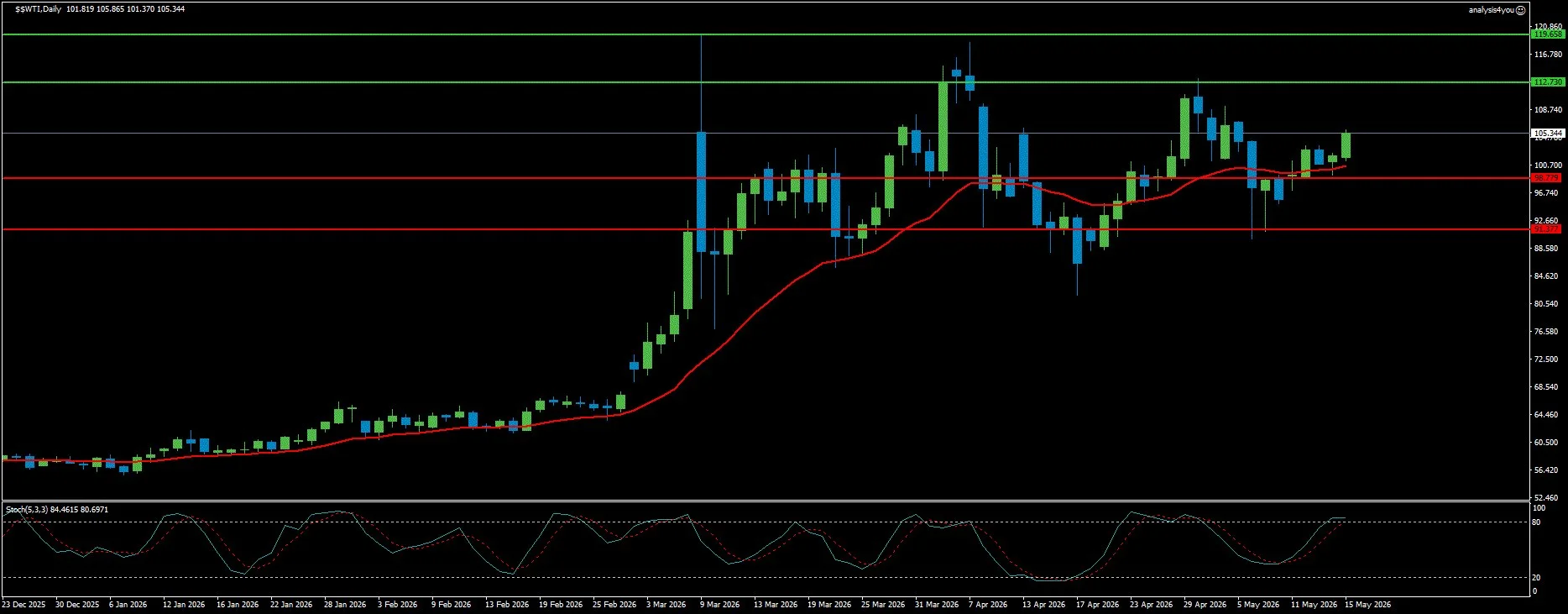
WTI Crude Oil: Re-escalation Confirmed, Tehran Toll Booth Is New Regime (105.34)
Current Trend: Bullish
Resistance: 112.73 | 119.66
Support: 98.78 | 91.38
WTI crude oil has surged back above $100 (from approximately $92 to 95 last week to $105.34). The re-escalation was triggered definitively by Trump’s rejection of Iran’s peace proposal (called garbage by Trump while the ceasefire was described as unbelievably weak). Saudi Aramco CEO Amin Nasser warned this week that the global market is losing roughly 100 million barrels of supply each week, adding that any return to normal conditions could slip into 2027. The most significant new structural development this week is Iran’s Tehran Toll Booth regime. Approximately 30 Chinese vessels plus LPG and crude carriers bound for India and Japan successfully crossed the Strait under Iran’s Iranian Management Protocol. Iran is reportedly charging $1 to 2 million per ship, payable in crypto, in exchange for safe passage through IRGC-controlled shipping corridors. This is not a reopening of the Strait. It is a managed chokepoint under armed escort. Companies paying those fees could face US sanctions. The week ahead for WTI is dominated by the continued evolution of the Tehran Toll Booth regime and whether Washington responds with sanctions. Any positive development from behind-closed-doors US-Iran negotiations would send WTI below $100 toward the $91.38 support. Any additional military escalation sends WTI toward $112.73. Technically, WTI is at $105.34, consolidating above the steeply rising MA. The Stochastic at 84.46/80.70 is overbought in a downtrend with a neutral signal. Resistance at 112.73 is the next war spike ceiling. Support at 98.78 / 91.38.
Crypto
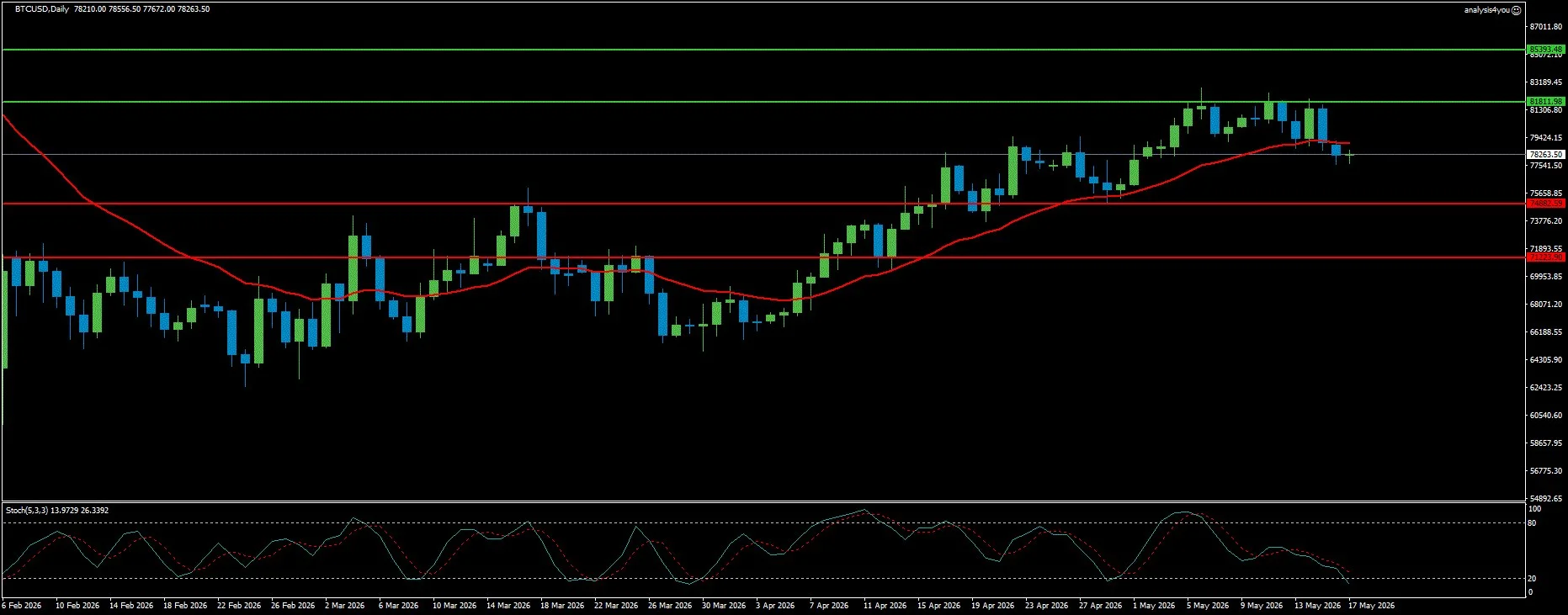
Bitcoin: First ETF Outflow Since March, Back Below $80K, Oversold Warning (78,264)
Current Trend: Cautiously Bearish
Resistance: 81,812 | 85,393
Support: 74,883 | 71,224
Bitcoin has retreated from the $80,598 level of last week to $78,264 (back below the $80,000 psychological support). The most significant institutional signal of the week was the reversal of the six-week positive ETF flow streak: spot Bitcoin ETFs recorded an outflow of $709.88 million through Thursday (and if Friday’s flows were negative, this would mark the first weekly outflow since the end of March). This signals a cautious stance among institutions. CryptoQuant’s on-chain data adds critical context. Unrealized profit margins reached 17.7% on May 5 (the highest since June 2025), creating elevated selling pressure. The Coinbase Bitcoin Price Premium chart has turned negative since late April (indicating that Bitcoin demand in the US has specifically slowed). The hotter-than-expected US inflation data (CPI 3.8%, PPI 6.0%) lifted market expectations for a more hawkish Fed, pricing in a nearly 40% chance of a Fed rate hike by year-end (a direct headwind for Bitcoin). The CLARITY Act advancing through the Senate Banking Committee 15-9 in a bipartisan vote is the week’s positive structural catalyst. The geopolitical dimension continues to suppress risk appetite. Trump stated he would not be much more patient with Iran. Technically, BTC is at $78,264. Below MA 20, above MA 50, below MA 200. The Stochastic at 13.97/26.34 is deeply oversold in a downtrend with a bearish signal. If BTC continues its correction, it could extend toward the 61.8% Fibonacci retracement at $78,490 (being tested right now). A close below $78,490 could extend losses toward $75,000. On the upside, initial resistance is the 200-day EMA at $82,092.
Key Events (May 18-22, 2026)
Monday, May 18: G7 Meeting begins. Warsh’s first full week as sole Fed Chair. China Industrial Production and Retail Sales for April. Japan Q1 GDP.
Tuesday, May 19: G7 Meeting continues. UK March Labour Market Data. Canada April Inflation. Fed’s Waller and Paulson speeches.
Wednesday, May 20: FOMC Minutes from the April 29 meeting (THE WEEK’S DEFINING POLICY EVENT). Will reveal whether non-voter dissenters shared the three official hawkish dissidents’ view. UK April Inflation Data (CPI, Core CPI, PPI, RPI).
Thursday, May 21: US May Preliminary S&P Global PMIs (the week’s primary growth read). EU and Germany May Preliminary HCOB PMIs. UK May Preliminary S&P Global PMIs. US Initial Jobless Claims. NVIDIA EARNINGS (the single most important company report of the week).
Friday, May 22: Germany Q1 GDP final. UK April Retail Sales. Germany May IFO Survey. US May Michigan Consumer Sentiment.
Week Ahead Outlook
The week of May 18 to 22 is the first full week of the Warsh era without Powell on the Board. The market has undergone a complete regime reversal in five trading days. The FOMC Minutes on Wednesday will either validate or challenge that repricing. The Nvidia earnings on Thursday will either sustain or challenge the AI-driven equity rally’s momentum.
Week Ahead Outlook
The week of May 18 to 22 is the first full week of the Warsh era without Powell on the Board. The market has undergone a complete regime reversal in five trading days. The FOMC Minutes on Wednesday will either validate or challenge that repricing. The Nvidia earnings on Thursday will either sustain or challenge the AI-driven equity rally’s momentum.
Scenario 1: Hawkish FOMC Minutes + Nvidia Miss + Iran Stalemate (approximately 30%):
FOMC Minutes reveal broad committee agreement on the need to consider rate hikes. Nvidia misses estimates. Iran Toll Booth regime remains operative. DXY breaks above 100.02 toward 100.80. EUR/USD breaks below 1.1509 toward 1.1415. GBP/USD breaks below 1.3179 toward 1.3012. S&P 500 pulls back toward 7,266 and potentially 7,155. Gold breaks below $4,500 toward $4,304. WTI consolidates $100 to 112. BTC breaks below $78,490 toward $75,000.
Scenario 2: Mixed FOMC Minutes + Nvidia Beat + Diplomatic Progress (approximately 40%):
FOMC Minutes show genuine division. Nvidia beats estimates decisively. Behind-closed-doors US-Iran progress reported. DXY consolidates 98.15 to 100.02. EUR/USD stabilizes 1.1509 to 1.1740. GBP/USD finds support at 1.3179 to 1.3459. S&P 500 holds 7,266 to 7,505. Gold holds $4,304 to $4,685. WTI $98 to 112. BTC stabilizes $74,883 to $81,812. This is the most likely base case.
Scenario 3: Dovish FOMC Surprise + Nvidia Beat + Iran De-escalation (approximately 30%):
FOMC Minutes reveal that the majority remain optimistic about inflation coming back down. Nvidia crushes estimates. Trump signals willingness to accept a modified Iran framework. WTI crashes below $100. DXY reverses toward 98.15 and 97.32. EUR/USD bounces toward 1.1740. GBP/USD recovers toward 1.3459. S&P 500 breaks 7,505 targeting 7,624. Gold surges toward $4,685. BTC breaks back above $80,000.
Bottom line: Eleven weeks into the Iran war, the market has entered its most volatile regime-change week since the conflict began. The Dollar’s reversal from lower to upper Bollinger Bands in a single week is the most decisive single-week currency move of the war. EUR/USD and GBP/USD’s move to their most extreme oversold Stochastic readings warns of violent technical bounces (but the trend is unambiguously lower). The S&P 500’s first bearish Stochastic signal since the March 30 bottom is the most important equity technical development since the rally began.


