How FX Hedging Costs Can Override Classic Safe-Haven Dollar Behavior
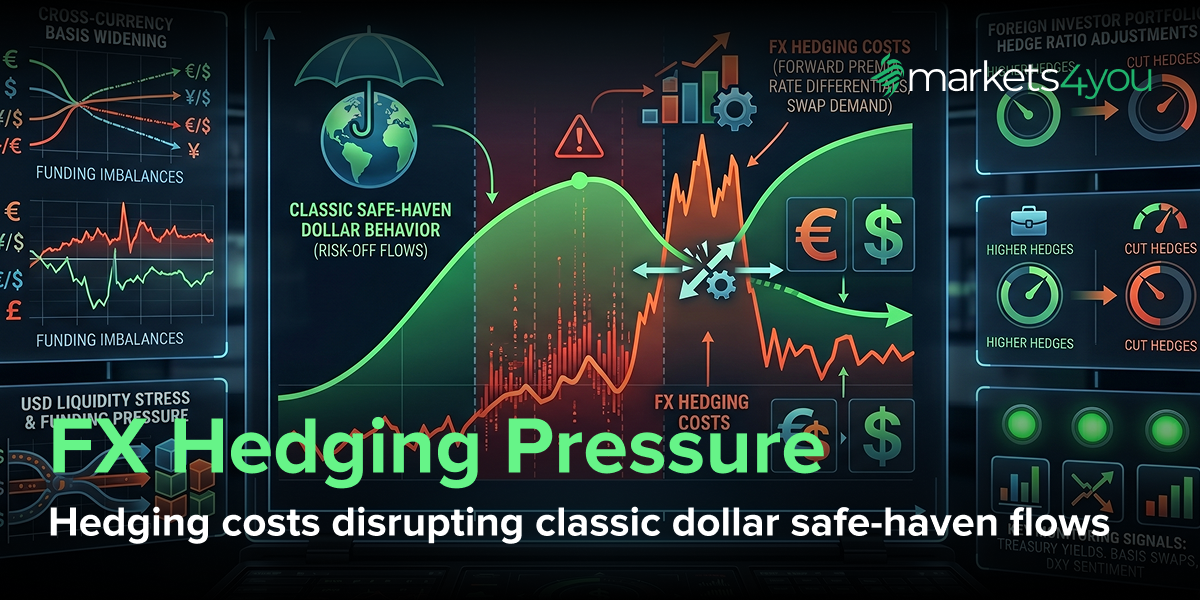
The US dollar has long been treated as the world’s ultimate safe-haven currency.
During periods of market stress, investors often move capital toward dollar-denominated assets in search of liquidity, stability, and perceived safety. This behaviour has appeared repeatedly across financial crises, geopolitical shocks, and global recessions.
As a result, many traders instinctively expect the dollar to strengthen whenever risk sentiment deteriorates.
But modern forex markets have become more complicated than the traditional “risk-off equals stronger dollar” narrative suggests.
In recent years, there have been periods where the dollar failed to behave like the textbook safe haven many traders expected. In some cases, the dollar even weakened during episodes of global uncertainty despite elevated market stress.
One reason involves FX hedging costs.
As global portfolio flows become increasingly interconnected, institutions are paying closer attention not only to asset returns, but also to the cost of protecting currency exposure. Rising hedging costs can significantly affect how foreign investors manage Treasury exposure, US equity allocations, and broader dollar-denominated assets.
When currency hedging becomes too expensive, non-US investors may reduce hedge ratios, delay hedging activity, or rebalance portfolios differently. In some environments, these adjustments can partially offset traditional safe-haven dollar demand.
As a result, the dollar does not always strengthen in a mechanically reliable way during global stress.
The interaction between yield differentials, forward pricing, cross-currency basis conditions, and portfolio rebalancing increasingly shapes modern dollar behaviour.
Understanding this relationship helps traders move beyond simplistic safe-haven assumptions and evaluate the broader macro forces influencing forex markets today.
Why the Dollar Is Usually Treated as a Safe-Haven Currency
The dollar’s safe-haven status is deeply connected to its role within the global financial system. The United States remains home to the world’s largest economy, the deepest government bond market, and one of the most liquid financial infrastructures in global finance. During periods of instability, investors often move capital toward US Treasuries and dollar liquidity. This creates structural US dollar demand during periods of stress. Historically, safe-haven flows have strengthened the dollar during periods of global uncertainty:- financial crises,
- banking instability,
- geopolitical conflict,
- recession fears,
- and sharp equity-market selloffs.
- strong US economic outperformance,
- and severe global risk-off conditions.
- hedge ratios,
- currency hedging costs,
- cross-border funding exposure,
- and balance-sheet efficiency.
- reduce currency hedging,
- alter portfolio allocations,
- or change hedging mandates entirely.
What FX Hedging Costs Actually Measure
FX hedging costs measure the expense associated with protecting investors against currency fluctuations when holding foreign assets. For non-US investors holding dollar-denominated assets, currency hedging helps reduce exposure to exchange-rate volatility. The goal is not necessarily increasing returns, but stabilising portfolio outcomes relative to the investor’s domestic currency. This process is especially common among:- pension funds,
- insurance companies,
- sovereign institutions,
- asset managers,
- and globally diversified portfolio investors.
- hedging expenses,
- funding pressure,
- and currency-adjusted outcomes.
How Higher US Rates Change the Cost of Hedging Dollar Exposure
Higher US interest rates have a major influence on dollar hedging behaviour. When the Federal Reserve raises rates aggressively while other major central banks remain relatively accommodative, the gap between US yields and foreign yields widens. This increases the forward premium foreign investors must pay to hedge dollar exposure. As a result, FX hedging costs rise. At first glance, higher US rates should support the dollar because they increase the yield advantage of holding dollar-denominated assets. This often attracts global capital into:- Treasuries,
- money-market instruments,
- and US fixed-income products.
- reduce hedge ratios,
- accept greater currency exposure,
- shift toward alternative assets,
- or rebalance away from dollar holdings entirely.
Why Foreign Investors Sometimes Cut Hedge Ratios Instead of Increasing Them
In theory, periods of uncertainty should encourage investors to hedge currency exposure more aggressively. But in practice, institutions do not always respond that way. When FX hedging costs rise sharply, many foreign investors face a trade-off between reducing currency risk and preserving portfolio returns. In some cases, maintaining full currency hedges becomes too expensive relative to the expected benefit. This is where hedge ratios become important. A hedge ratio refers to the percentage of foreign currency exposure an investor chooses to protect through forwards or swap markets. Under stable conditions, many institutions maintain relatively consistent hedging mandates. But when rate differentials widen and FX hedging costs increase, those hedge ratios may begin changing. Instead of automatically increasing dollar hedging during risk-off environments, some investors may:- reduce hedge ratios,
- delay hedging activity,
- shorten hedging duration,
- or selectively hedge only portions of their portfolio exposure.
- liquidity needs,
- collateral usage,
- capital requirements,
- and portfolio volatility targets.
How Cross-Currency Basis and Forward Pricing Reveal Hidden Dollar Stress
One of the most useful indicators for understanding hidden dollar stress is the cross-currency basis swap market. Institutional investors monitor basis conditions closely because they reveal imbalances in dollar funding and hedging demand. Under covered interest parity, forward exchange rates should theoretically reflect differences between interest rates across currencies. But during periods of stress, funding pressure and hedging demand imbalances can distort this relationship. This distortion appears through the cross-currency basis. A widening negative basis often signals elevated demand for dollar funding relative to available supply. In practical terms, it means non-US investors are paying increasingly high costs to obtain or hedge dollars through swap markets. This can reveal hidden forex funding stress even when spot markets appear relatively stable. Cross-currency basis conditions often deteriorate during:- liquidity crises,
- banking instability,
- severe risk-off periods,
- or sharp increases in dollar funding demand.
When Safe-Haven Demand and Hedging Flows Start Pulling in Opposite Directions
One of the most important developments in modern forex markets is that safe-haven demand and hedging flows do not always move in the same direction. Historically, traders often assumed that rising uncertainty would naturally strengthen the dollar through defensive capital inflows. But in today’s interconnected financial system, portfolio hedging behaviour can sometimes offset or distort those classic safe-haven flows. This creates more complicated dollar dynamics. For example, during a global risk-off event:- some investors may rush into dollar assets seeking safety,
- while others may simultaneously reduce dollar hedging because FX hedging costs become too expensive.
- uneven dollar positioning,
- inconsistent DXY behaviour,
- or unusual moves in major currency pairs.
- safe-haven flows,
- portfolio rebalancing,
- dollar hedging,
- and funding pressure
- local rate differentials,
- institutional hedging demand,
- central bank policy divergence,
- and funding-market conditions.
What This Means for EUR/USD, USD/JPY, and Other Major Pairs
The interaction between FX hedging costs and safe-haven flows has important implications for major forex pairs. EUR/USD is highly sensitive to rate differentials and hedging dynamics because European institutions maintain large exposures to dollar-denominated assets. When US yields rise aggressively relative to European yields, hedging dollar exposure into euros becomes more expensive. This may initially support the dollar through higher yield attraction, but over time it can also encourage hedge-ratio adjustments and portfolio rebalancing. USD/JPY is often even more sensitive to hedging pressure. Japanese institutions are among the world’s largest holders of foreign assets, particularly US Treasuries. Because Japanese yields historically remained far below US yields, the cost of hedging dollar exposure into yen can become extremely expensive during periods of elevated US rates. This creates important allocation decisions for Japanese investors. Some may:- reduce hedge ratios,
- tolerate greater dollar exposure,
- or shift portfolio allocations entirely.
- central bank policy divergence,
- local funding conditions,
- and regional portfolio behaviour.
- hedging demand imbalance,
- funding-market stress,
- cross-border portfolio positioning,
- and central bank divergence.
Practical Signals Traders Can Monitor Without Trading FX Swaps Directly
Most retail traders do not participate directly in FX swap markets or institutional hedging programs. However, traders can still monitor several practical signals that help reveal shifts in hedging pressure and broader dollar funding conditions. One of the most important indicators is Treasury yields. Rising US yields often increase FX hedging costs for non-US investors, particularly when rate differentials widen significantly relative to Europe or Japan. Traders should therefore monitor:- US 2-year yields,
- 10-year Treasury yields,
- and major central bank policy expectations.
- rising dollar funding demand,
- increased hedging pressure,
- or growing forex funding stress.
- dollar liquidity,
- forward pricing,
- hedging demand,
- and global portfolio flows.
- Treasury yields rise,
- global risk sentiment weakens,
- yet the dollar struggles to strengthen consistently,
Summary
The dollar remains one of the world’s most important safe-haven currencies, but modern forex markets have made its behaviour far more complex than traditional macro narratives suggest. Today, dollar movement is increasingly influenced not only by risk sentiment, but also by FX hedging costs, hedge-ratio adjustments, funding pressure, and global portfolio flows. When US yields rise sharply relative to foreign yields, the cost of hedging dollar exposure can increase significantly for non-US investors. This may encourage institutions to reduce hedge ratios, alter portfolio allocations, or rebalance exposure differently. As a result, safe-haven demand and hedging flows do not always reinforce one another. In some environments, these forces may even pull in opposite directions, creating periods where the dollar behaves inconsistently despite elevated global uncertainty. Understanding concepts such as:- currency hedging,
- cross-currency basis,
- forward pricing,
- and funding stress
FAQ
- What are FX hedging costs?
- Why can the US dollar weaken even during risk-off periods?
- What is the cross-currency basis in forex markets?
- How do hedge-ratio changes affect dollar demand?
- What indicators can traders watch to track hedging pressure?


