Dollar Surges to 99.70 as Iran War Sends Oil to $91, Jobs Crash -92K
Market Sentiment Overview
Markets ended the first full week of the US-Israel-Iran war in full risk-off mode, with the Dollar Index surging to four-month highs near 99.70 as safe-haven flows overwhelmed all other considerations. The conflict exceeded worst-case scenarios—Iran closed the Strait of Hormuz (blocking 20% of global oil), retaliated with missiles on US bases across four Gulf nations, while Hezbollah attacked a British NATO base in Cyprus. WTI crude exploded 35% weekly to $91 (the biggest gain since 1983), with Qatar’s Energy Minister warning prices could hit $150 if war persists. Friday’s catastrophic NFP showed the US lost 92,000 jobs (versus +59K expected) with unemployment rising to 4.4%, yet the Dollar rallied on stagflation fears—weak growth plus energy-driven inflation. The S&P 500 posted its worst week since October, plunging 2% to 6,740 as oil’s surge threatens to reignite inflation already running at 3% core PCE. EUR/USD suffered its largest weekly decline in over a year, crashing below 1.1600 as European inflation unexpectedly rose to 1.9% and markets began pricing ECB rate hikes. GBP/USD crumbled to three-month lows near 1.3250. Gold paradoxically fell despite war, closing near $5,170 as relentless Dollar strength overwhelmed safe-haven demand. Bitcoin defied crash predictions, holding $67,317 amid early-week $1.14B ETF inflows before Thursday’s $228M reversal. The week ahead features Wednesday’s US CPI (expected 2.5% versus 2.4%) and Friday’s GDP/PCE data—but all economics are subordinate to one question: does oil hit $100+ and trigger global recession?
Currencies
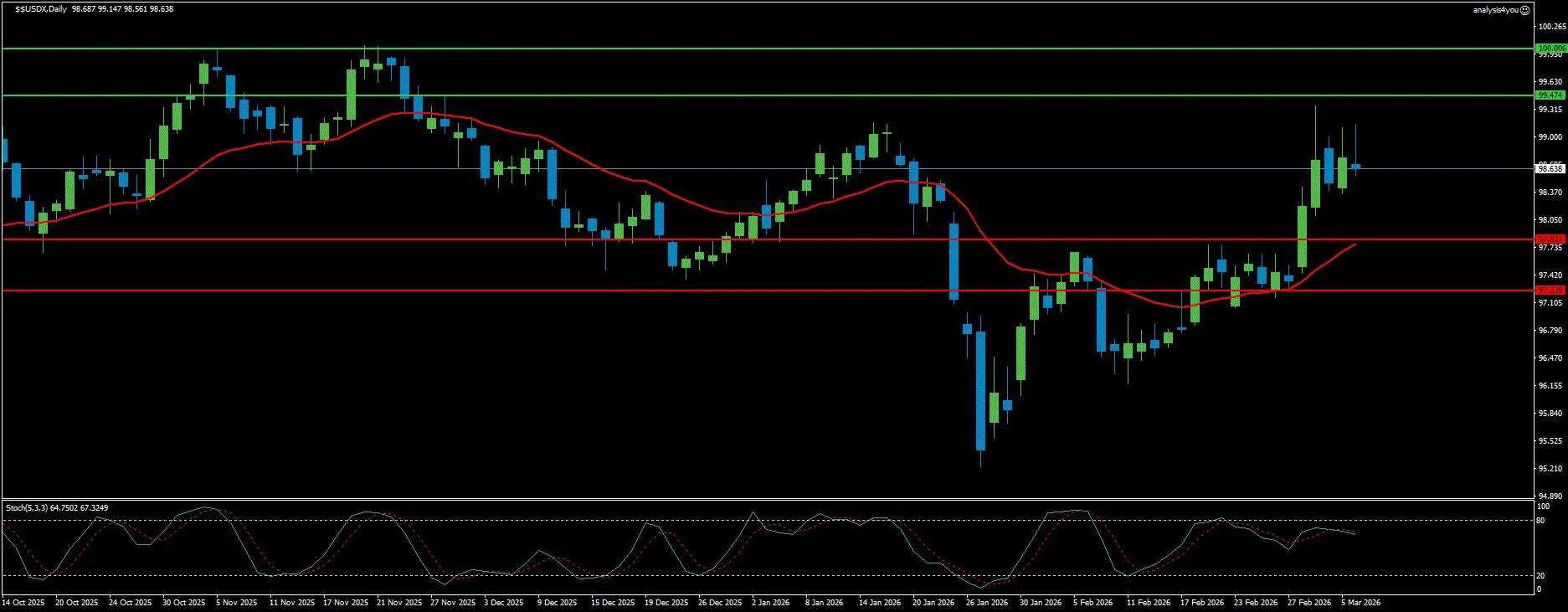
USD Index: Safe Haven Triumph at Four-Month Highs (98.64)
Current Trend: Strongly Bullish
Market Sentiment: Risk-Off Dominance
Resistance: 99.47 | 100.01
Support: 7.82 | 97.24
The Dollar Index surged to 98.64, posting its largest weekly gain in over a year after touching 99.70 intraweek. The Greenback emerged as the undisputed winner, functioning as an ultimate safe haven despite fundamentals that would traditionally weaken it. Flight-to-safety flows combined with surging oil ($91 WTI, +35% weekly) revived inflation fears that eliminate Fed rate cut probability. Friday’s NFP disaster (economy lost 92K jobs versus +59K expected, unemployment 4.4%) would normally crush the Dollar, but the stagflation narrative—weak growth plus energy inflation—paradoxically strengthens USD. ISM Manufacturing remained above 50 (expansion), Services PMI jumped to 56.1 from 53.8, while Prices Paid Index surged to 70.5 from 59. CME FedWatch now prices only one 2026 cut (September), down from three before the war. Fed speakers are divided: Williams sees cuts possible if inflation moderates, Kashkari prefers waiting, Schmid argues inflation is too high, and Hammack urges patience. Scotiabank notes “25bps cut not fully priced until September.” CFTC positioning shows net shorts at -1.8K contracts, but open interest fell for the fourth straight week to 26.2K—thin positioning vulnerable to squeezes. Resistance at 99.47 must break to challenge the 100.01 psychological barrier. Support at 97.82 provides a floor, with 97.24 a stronger base—but given Iran’s persistence and oil trajectory, downside appears limited.
EUR/USD: Largest Weekly Decline in Over a Year (1.1616)
Current Trend: Bearish
Market Sentiment: Extremely Negative
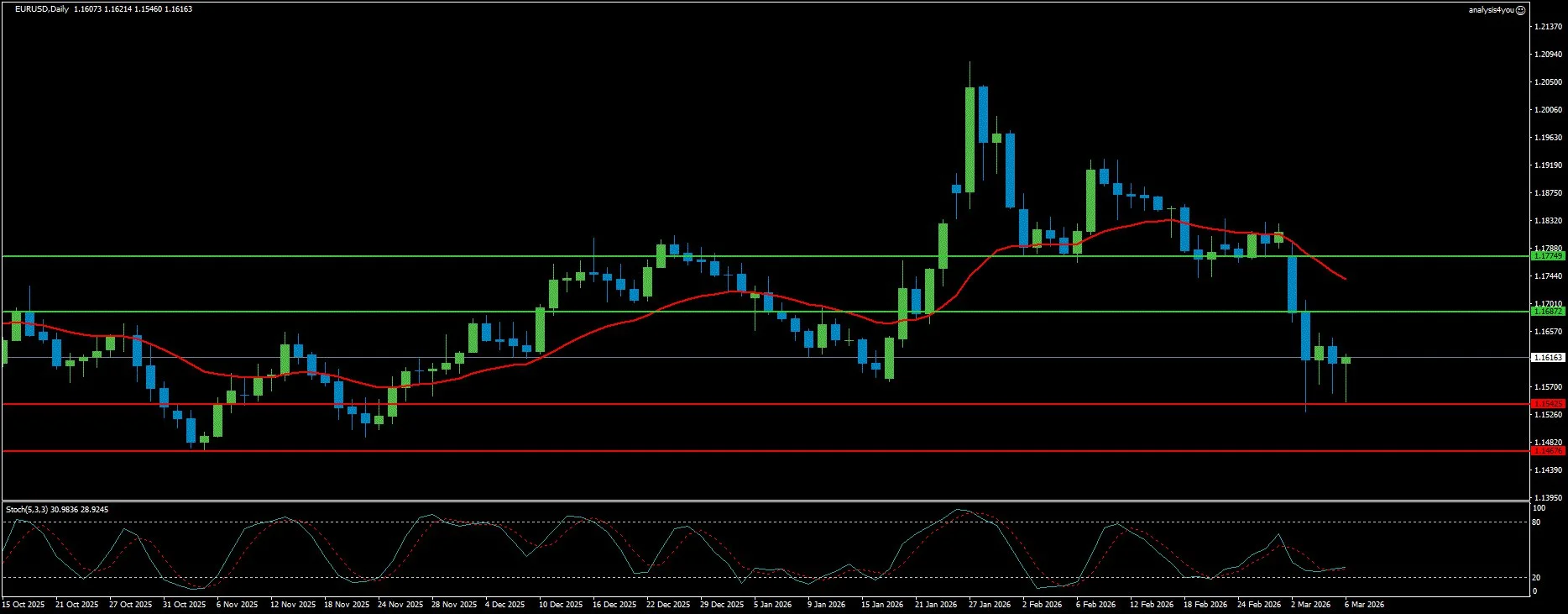
Resistance: 1.1687 | 1.1775
Support: 1.1543 | 1.1468
EUR/USD collapsed to 1.1616, posting its largest weekly decline in over a year as the pair crashed through 1.1700, briefly testing 1.1530 before a modest Friday recovery. The Euro ranks among the worst performers as Iran’s war energy shock hits Europe hardest—Qatar’s LNG halt sent European energy prices soaring, while February HICP inflation unexpectedly rose to 1.9% (versus 1.7% expected). PPI jumped 0.7% monthly after January’s -0.3% decline. Markets immediately began pricing ECB rate hikes before year-end—a dramatic reversal from Lagarde’s “good place” dovish stance. The equation is brutal: Q4 GDP revised down to 1.2% (from 1.4%), showing growth deterioration, while inflation approaches 2% target with $90+ oil guaranteeing it surges above in the coming months. “A 20% spike in energy prices is no joke,” analysts note. Europe relies on energy imports, and EU demand will add to higher prices. Technically, price slipped below all moving averages, with the 20-day SMA near 1.1800 gaining downward traction. RSI maintains a bearish slope in the 30 area. Weekly chart shows a slide below the 20-week SMA around 1.1700, indicating the first stages of a sustained bearish trend. Resistance at 1.1687 needs clearing to ease pressure toward 1.1775. Critical support at 1.1543 provides a floor, with strong static support at 1.1468—break below confirms mid-term downward continuation targeting 1.1400.
GBP/USD: Three-Month Lows Amid Political Drama (1.3406)
Current Trend: Bearish
Market Sentiment: Vulnerable
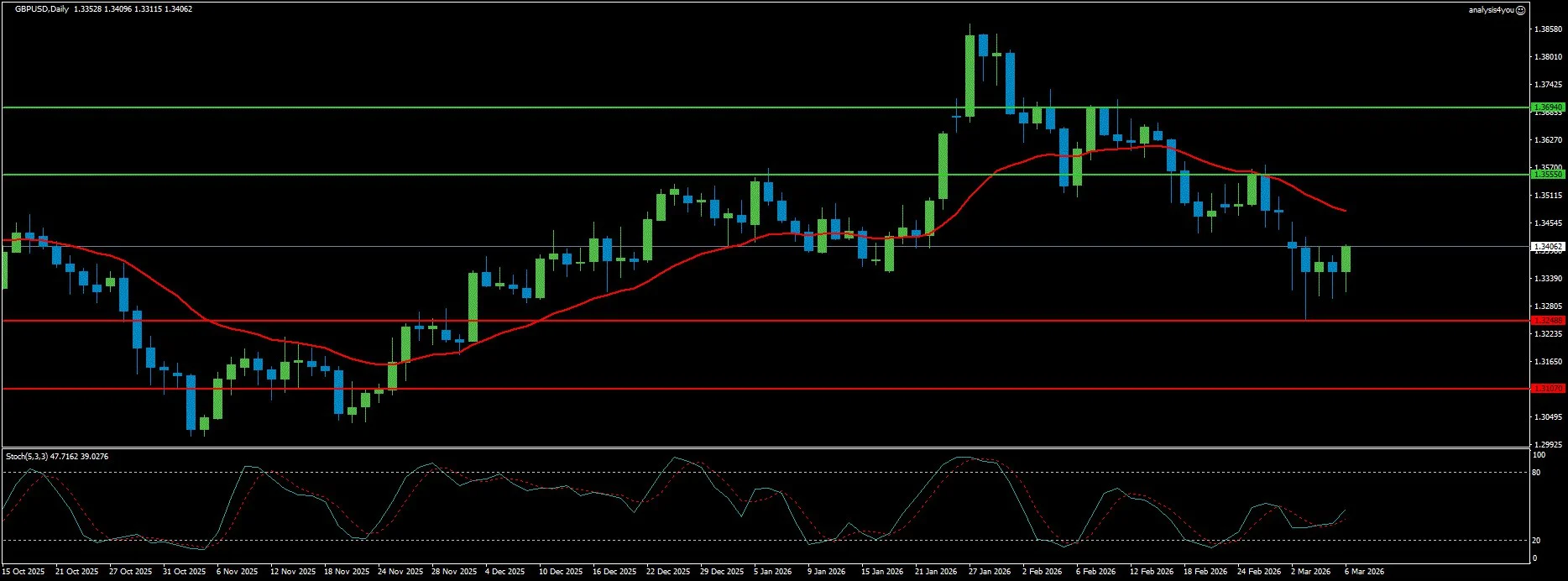
Resistance: 1.3555 | 1.3694
Support: 1.3249 | 1.3107
Sterling crumbled to 1.3406 after testing three-month lows near 1.3250, suffering the double blow of Iran war risk-off and UK political drama. The Green Party’s historic Westminster by-election win handed PM Starmer an embarrassing defeat. Markets doubt BoE will cut at the March 19 meeting as the Middle East conflict raises stagflation risks—UK inflation is well above 2% target, and energy price increases discourage easing. Technical positioning shows bearish bias with spot below 21/50-day SMAs approaching 100/200-day SMAs around 1.3400. RSI near 34 reinforces bearish momentum without oversold conditions. Mixed fundamentals: unemployment at five-year high 5.2%, wages decelerated to 4.2%, but retail sales surged 1.8% (largest since May 2024), Composite PMI rose to 53.9 (highest since April). Bailey signaled “scope for cuts,” but the narrative of “sharp inflation drops” now clashes with the $90+ oil reality. Resistance at 1.3555 needed to target 1.3694. Support at 1.3249 must hold to maintain structure, with 1.3107 as a deeper floor.
Stocks
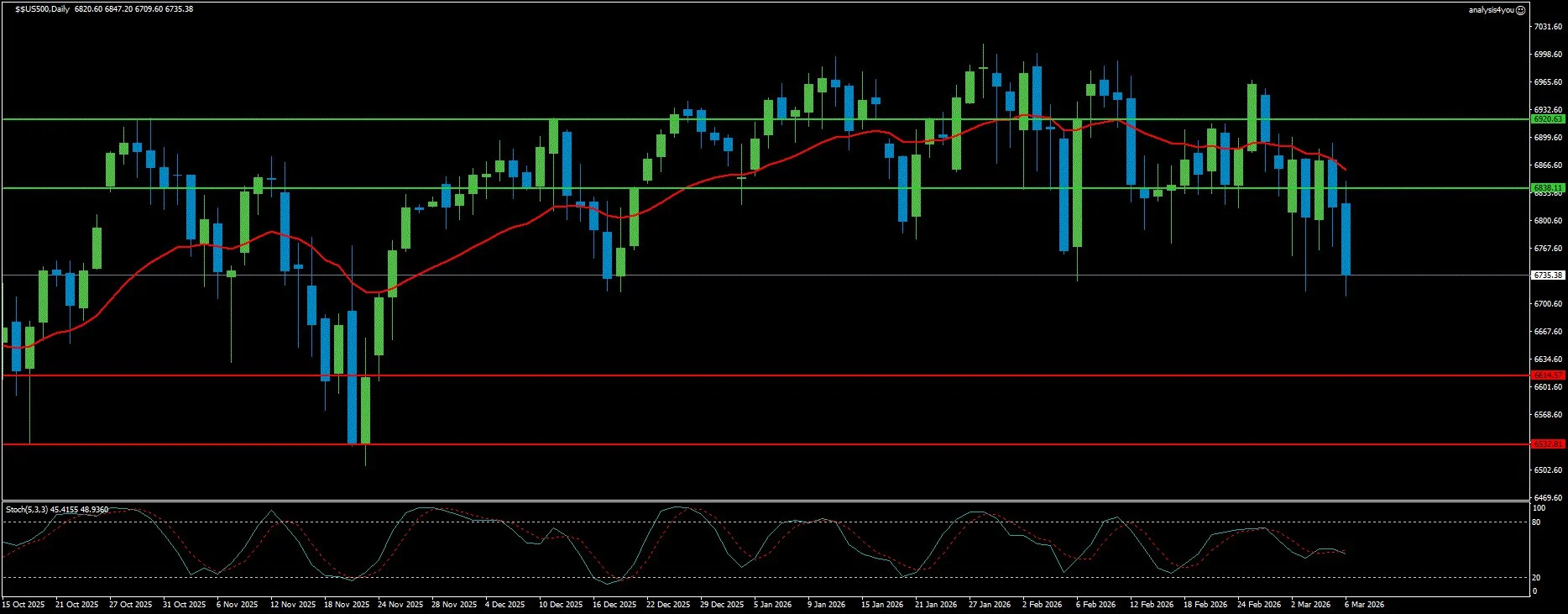
S&P 500: Worst Week Since October, Stagflation Looms (6,735)
Current Trend: Bearish Below Key Support
Market Sentiment: Risk-Off
Resistance: 6,838 | 6,921
Support: 6,615 | 6,533
The S&P 500 closed at 6,735, down 2% weekly—worst performance since October—breaking decisively below critical 6,765-6,775 support Friday. The index fell 1.3% Friday after opening down 1.7% as WTI breached $90. Analysts warn investors may be too complacent—index is less than 4% from its highs despite cascading risks. “Initial investor reaction to this war has been very tame,” notes Argent Capital’s Ellerbroek. “Investors assume Trump settles for something reasonable.” However, Trump’s Friday “UNCONDITIONAL SURRENDER” demand with “no time limits” suggests no quick exit. Stagflation setup is explicit: -92K NFP confirms labor deterioration, while 35% oil surge threatens to push inflation above Fed’s 2% target. Every $10 crude increase adds 0.3-0.4 percentage points to CPI over 3-6 months—$90+ oil could push CPI toward 3.5-4.0% by summer. Fed’s Waller noted oil spike “problem if energy prices unwound in weeks,” but “broader impact if it lasts longer.” Defense stocks rallied 2.1-4.4% weekly (RTX, Lockheed, Northrop). CFRA’s Stovall identifies $100 oil as a level “above which investors would think we’re heading for something worse.” Friday’s breakdown through 6,765-6,775 exposes 6,615 critical level, with deeper support at 6,533. Break below 6,615 confirms defensive rotation signals genuine distribution.
Commodities
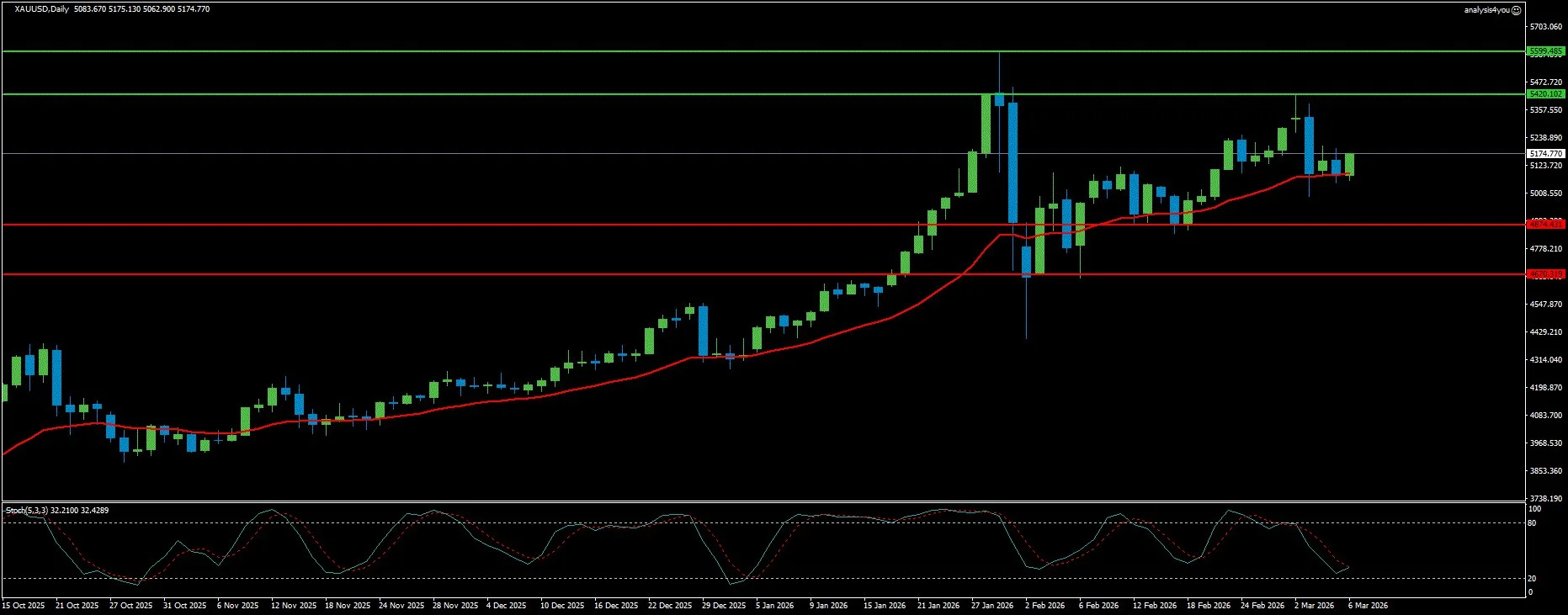
Gold: War Fails to Lift XAU/USD Despite Monday Gap (5,175)
Current Trend: Consolidating (Fading Bullish Bias)
Market Sentiment: Mixed
Resistance: 5,420 | 5,600
Support: 4,874 | 4,670
Gold closed near $5,170, snapping a four-week winning streak despite Monday’s bullish gap above $5,400 following Iran strikes. Failure to capitalize on safe-haven flows reveals a critical dynamic: persistent Dollar strength ($98.64, four-month highs) overwhelmed geopolitical demand, while surging oil revived inflation fears supporting USD over gold. RSI declined toward 50, with Gold fluctuating around 20-day SMA—loss of bullish momentum. The 23.6% Fibonacci retracement and 20-day SMA form a pivot at $5,090-$5,100. Below this activates sellers toward $4,875-$4,865 (38.2% Fibo, 50-day SMA). ING’s Manthey argues, “structural drivers support Gold—geopolitical fragmentation sustains central bank demand. Fed cuts in Q2 would support Gold, lowering real yields.” However, markets reassessing Fed outlook given stagflation—only one 2026 cut (September) priced. Resistance at 5,420 needs clearing before the 5,600 all-time high. Paradox intensifies if oil hits $100+: could trigger Fed hikes, strengthening Dollar and pressuring Gold despite war. Support at 4,874 should hold, with 4,670 as the floor.
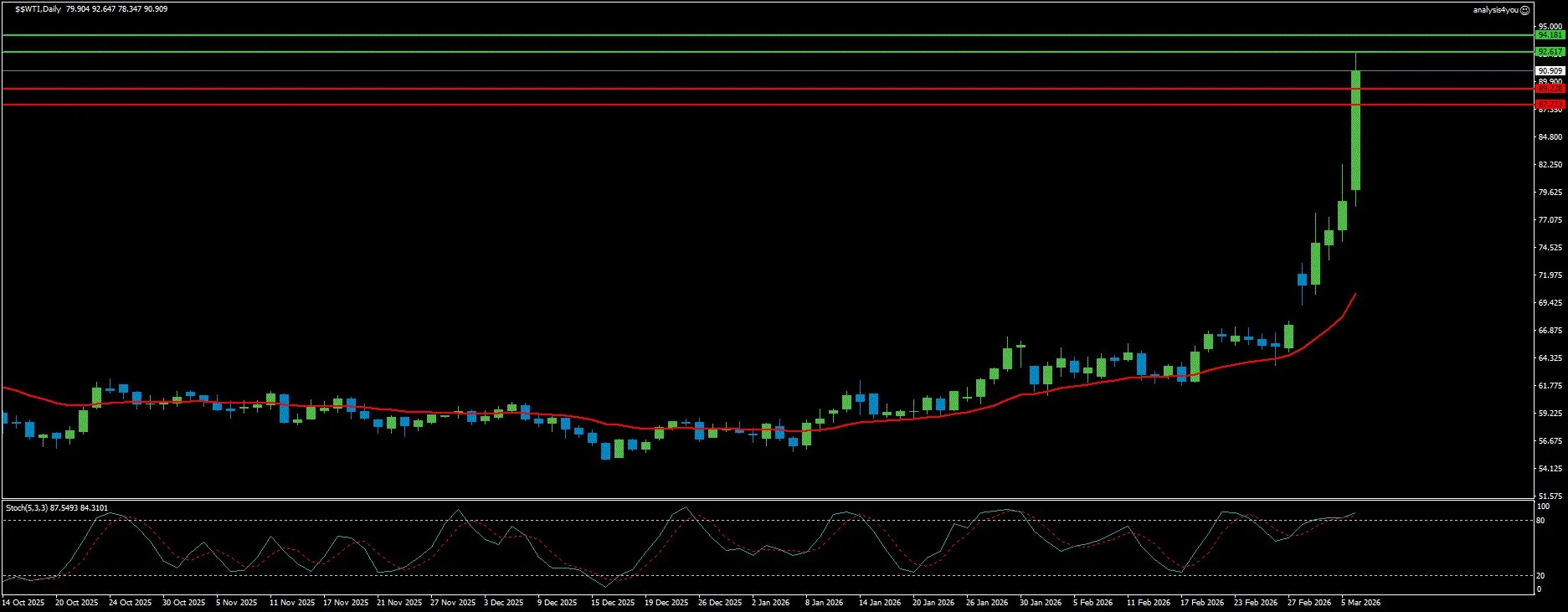
WTI Crude Oil: $91 After Historic 35% Weekly Surge (90.91)
Current Trend: Explosively Bullish
Market Sentiment: Fear (Supply Shock)
Resistance: 92.62 | 94.18
Support: 89.23 | 87.72
WTI closed Friday at $91 after touching $91.27, capping a historic 35% weekly surge—the biggest since 1983, the steepest since the Ukraine invasion. Qatar’s Energy Minister delivered an alarming warning: war could drive oil to $150, adding that even if war ended immediately, “weeks to months” to normalize deliveries. Strait of Hormuz remains effectively closed—traffic down 70%, 150+ tankers anchored—blocking 20% global oil, 23% LNG. Iran’s Guards told ships that passage was prohibited, with two vessels attacked. US Energy Secretary Wright promised Navy escorts “as soon as reasonably possible,” but comments failed to trigger a correction. Trump’s “unconditional surrender” demand eliminates a quick resolution. Fed’s Waller: oil spike “problem if unwound in weeks,” but “risk if effects become permanent.” The technical picture shows WTI surging through $85.53 resistance, opening the path toward April 2024 double-top $87.61 and $90—both decisively breached. Daily/weekly studies are strongly overbought, suggesting profit-taking is possible, but dips are likely to be limited. Resistance at 92.62 leads to 94.18, with the $100 psychological barrier now in play. Support at 89.23 and 87.72 should contain corrections.
Crypto
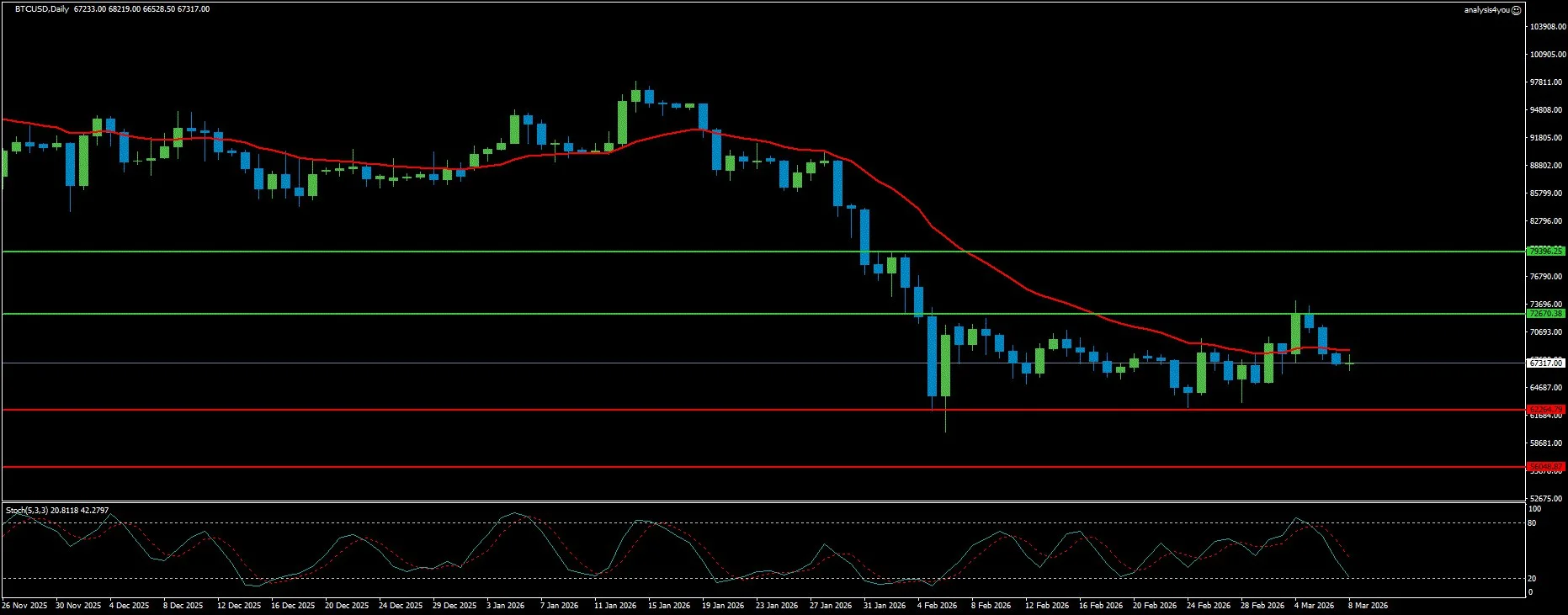
Bitcoin: Defies Crash Predictions, Holds Above $67K (67,317)
Current Trend: Resilient (Range-Bound)
Market Sentiment: Cautiously Positive
Resistance: 72,670 | 79,396
Support: 62,265 | 56,049
Bitcoin stabilized at $67,317, defying crash predictions following Iran strikes. “After the US-Israel struck Iran, consensus was for sharp crypto declines. Well, it didn’t happen. Crypto is weathering the storm much better than other risky assets,” analysts note. The early week saw BTC charge above $73,000 with $1.14B ETF inflows across three days, breaking a five-week outflow streak. Thursday’s reversal brought $228M outflows as oil accelerated toward $90. Fifth consecutive monthly loss looms—longest streak since August-December 2018. February closing -14.51% after January’s -10.17% marks rare consecutive losses starting the year (only 2014, 2018). Strategy purchased just 592 BTC on Monday (total 717,722 at $76,020 average), down from 2,486 the prior week. Rising oil creates headwinds—Fed study shows every $10 crude adds 20 basis points to CPI. Sustained high oil could prompt Fed hikes, bearish for crypto. Waller: oil “problem if unwound in weeks,” but “broader impact if lasts longer.” Jane Street lawsuit for UST/LUNA insider trading raises forced selling concerns—$19M BTC deposited to institutional exchanges. CryptoQuant confirms “deleveraging and cooling, but not bottom.” CME futures curve slope trending lower, mirroring pre-2018/2021 bears. Monthly realized losses just 0.3M BTC versus 1.1M at the 2022 bottom—incomplete capitulation. MVRV outsidethe extreme undervalued zone. Analysts predict “$55K ultimate bottom” with realized price 18% below current. Resistance at 72,670 must clear decisively to alleviate pressure, with 79,396 extended target. Critical support 62,265 is make-or-break—breach exposes 56,049 aligned with $55K capitulation prediction. Daily RSI at 42 neutral after rebounding from oversold. Weekly RSI 27 remains oversold. Range-bound $65K-$74K likely for the week.
Key Events This Week (March 9-13, 2026)
Geopolitical – DOMINATES EVERYTHING
- Strait of Hormuz closure ongoing (150+ tankers, 20% oil blocked)
- Trump demands “unconditional surrender”—no time limits
- Oil trajectory: $100 triggers recession, stagflation explicit
- US Navy escort operations versus Iran escalation
Major Data
- Wednesday: US CPI (Feb—expect 2.5% YoY vs 2.4%), critical given oil surge
- Thursday: UK Monthly GDP, BoE Governor Bailey remarks
- Friday: US Q4 GDP Preliminary (consensus 3.7%), Core PCE (Jan—Fed’s preferred gauge), JOLTS Job Openings
Fed Calendar
- Saturday, March 7: Blackout begins ahead of March 17-18 FOMC
- No Fed speakers this week
- Focus: How Fed reconciles -92K NFP with 3% PCE and $90+ oil
Other
- Monday: Daylight Saving in North America (data one hour earlier for Europe)
- Defense stocks momentum (RTX, LMT, NOC up 2.1-4.4%)
Week Ahead Outlook
The week faces binary outcomes: either the US Navy reopens Hormuz and oil retreats toward $70-75, or the strait stays closed and oil surges toward $100+, triggering a global recession. Everything else is subordinate.
Wednesday’s US CPI takes on historic importance. February data captures only early energy price increases before oil’s 35% explosion. Consensus expects 2.5% YoY (up from 2.4%). Any upside surprise validates the stagflation narrative and triggers aggressive Fed repricing. Markets price only one 2026 cut (September). CPI at 2.6-2.7%+ raises the probability of zero cuts or even hikes if oil sustains $100, strengthening the dollar toward 100.01 and pressuring EUR/USD toward 1.1468.
Friday delivers Q4 GDP (consensus 3.7%) and core PCE. GDP covers October-December, divorced from war reality—largely irrelevant except as history. Core PCE matters enormously. December ran hot at 3.0%. January confirmation of 3%+ inflation, combined with Wednesday CPI and $90+ oil, makes the Fed’s dilemma explicit: cut to support weakening labor (-92K NFP), risking an inflation spiral, or hold/hike while the economy deteriorates. Scotiabank: “25bps not priced until September, reflecting material softening from stronger data and Iran conflict.”
Geopolitics overwhelm economics. Trump’s “unconditional surrender” demand eliminates a quick resolution. Qatar warns of $150 oil sets upside target. Energy Secretary Wright’s Navy escort promise provides only a catalyst for crude retreat, but Iran warned “decisive response.” The House rejected limits on Trump’s military action Thursday—a free hand. Iranian FM told NBC Iran “rejected negotiations”—conflict remains in escalation phase.
Technical setups are clean. Dollar at 98.64 targeting 99.47 then 100.01—war persistence makes this likely. EUR/USD at 1.1616 faces 1.1543, then critical 1.1468—break targets 1.1400. GBP/USD at 1.3406 must hold 1.3249 or cascade to 1.3107. S&P 500 at 6,735 broke 6,765-6,775 Friday—holding below targets 6,615 then 6,533.
Gold at $5,175 is the wildcard. Failure to sustain Monday’s $5,400 gap reveals Dollar trumps geopolitical premium. However, if oil hits $100+ and stagflation consensus forms, Gold could rally as investors price Fed error. Support 4,874 should hold, 4,670 ultimate floor. Resistance 5,420 needed to reignite the bull trend.
WTI at $90.91 is a pure geopolitical play. Resistance 92.62 and 94.18 likely taken out if Hormuz stays closed through Wednesday. $100 psychological barrier sits just above—Qatar’s $150 warning no longer unthinkable if conflict extends. Support 89.23 and 87.72 minimal protection—sharp retreat requires war de-escalation or Navy success, both low-probability near-term.
Bitcoin at $67,317 demonstrated resilience, defying crash predictions, but faces Jane Street concerns and oil pressure. Range-bound $65K-$74K likely, with 72,670 daily close needed for bullish confirmation. Break below 62,265 exposes 56,049 capitulation zone, aligning with analysts’ $55K ultimate bottom.
Iran war entered week two with zero resolution signs, $90+ oil achieved, stagflation narrative established, and NFP confirming labor deterioration. This is no longer tail risk—it’s base case. Markets pricing “Trump finds off-ramp” bet against his explicit statements. Until Hormuz reopens or oil craters, risk-off and USD strength are the only trades. Position accordingly.


