CPI Shock Meets War Fatigue: Dollar at 99, Oil Retreats, Markets Seek Direction

Market Sentiment Overview
Markets enter the third week of the US-Israel Iran war caught between conflicting forces—Wednesday’s shocking CPI print (2.9% headline versus 2.5% expected, core 3.1% versus 2.6%) sent the Dollar Index briefly above 99.00 to four-month highs, yet Friday saw broad risk-on rotation as war fatigue set in. WTI crude retreated from $91 highs after the US Energy Secretary confirmed Navy escort operations through Strait of Hormuz would begin “within days,” easing immediate supply panic despite 150+ tankers remaining anchored. The S&P 500 stabilized at 6,735 after testing the critical 6,615 support, while defensive sector leadership persists—a pre-correction warning that has preceded 10%+ drawdowns in 63% of historical instances. EUR/USD found tentative support at 1.1616 following last week’s brutal collapse, as markets began pricing ECB rate hikes with European inflation at 1.9%. GBP/USD at 1.3406 clings to the 200-day SMA despite the BoE March 19 meeting widely expected to deliver a 25bps cut. Gold consolidated near $5,175 as relentless Dollar strength overwhelmed geopolitical safe-haven demand. Bitcoin demonstrated resilience at $67,317, holding above critical $62,265 support despite its fifth consecutive monthly loss. The week ahead features the FOMC decision Wednesday and BoE Thursday—but the dominant narrative remains whether $100 oil materializes or Hormuz reopening sends crude toward $70s.
Currencies
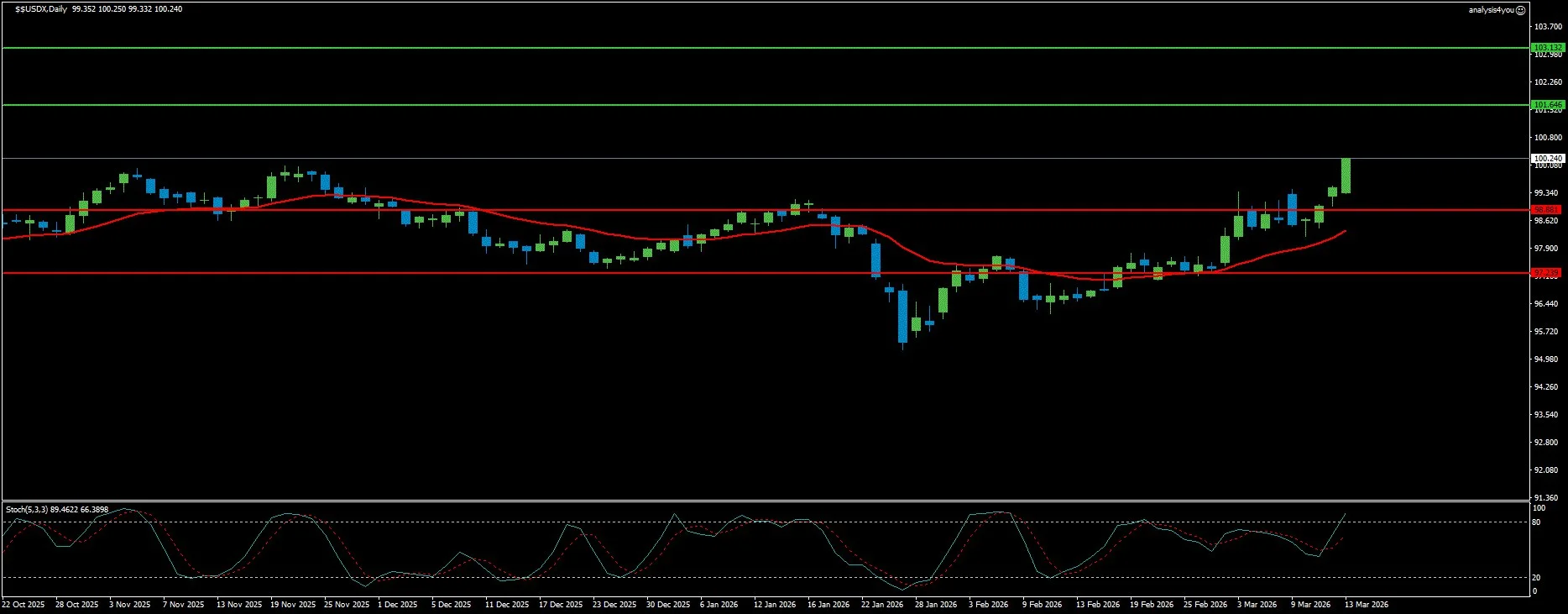
USD Index: CPI Shock Pushes to 99, But Can It Hold? (98.64)
Current Trend: Bullish (Testing Key Resistance)
Market Sentiment: Stagflation Fears
Resistance: 99.47 | 100.01
Support: 97.82 | 97.24
The Dollar Index trades at 98.64 after Wednesday’s CPI bombshell sent it briefly above 99.00 to four-month highs before Friday profit-taking. The inflation report delivered shocks: headline 2.9% YoY (versus 2.5% consensus), core 3.1% (versus 2.6%), with monthly readings of 0.4% headline and 0.5% core—both well above forecasts. Energy showed oil’s early impact, with gasoline up 2.3% monthly. Core services inflation reaccelerated to 4.2% from 3.9%, suggesting broad-based pressures beyond energy. Markets slashed Fed cut expectations—CME FedWatch now prices zero chance of March cut, just 45% for June (down from 80% pre-CPI), and only 65% odds of any 2026 easing. Stagflation narrative is explicit: prior week’s -92K NFP confirmed labor deterioration, while CPI proves inflation isn’t cooperating. Fed enters blackout Saturday ahead of March 17-18 FOMC, with Powell facing impossible choices: acknowledge inflation persistence (hawkish, supports USD) or emphasize labor fragility (dovish, pressures USD). CFTC positioning thin with net shorts at -1.8K and open interest at fourth weekly decline to 26.2K. RSI at 63 shows momentum without overbought. Resistance at 99.47 is gateway to 100.01—breakout likely triggers stops toward triple digits. Friday’s pullback from 99.20s suggests resistance genuine. Support at 97.82 provides floor, with 97.24 stronger base. Key variable is whether Hormuz developments override CPI hawkishness.
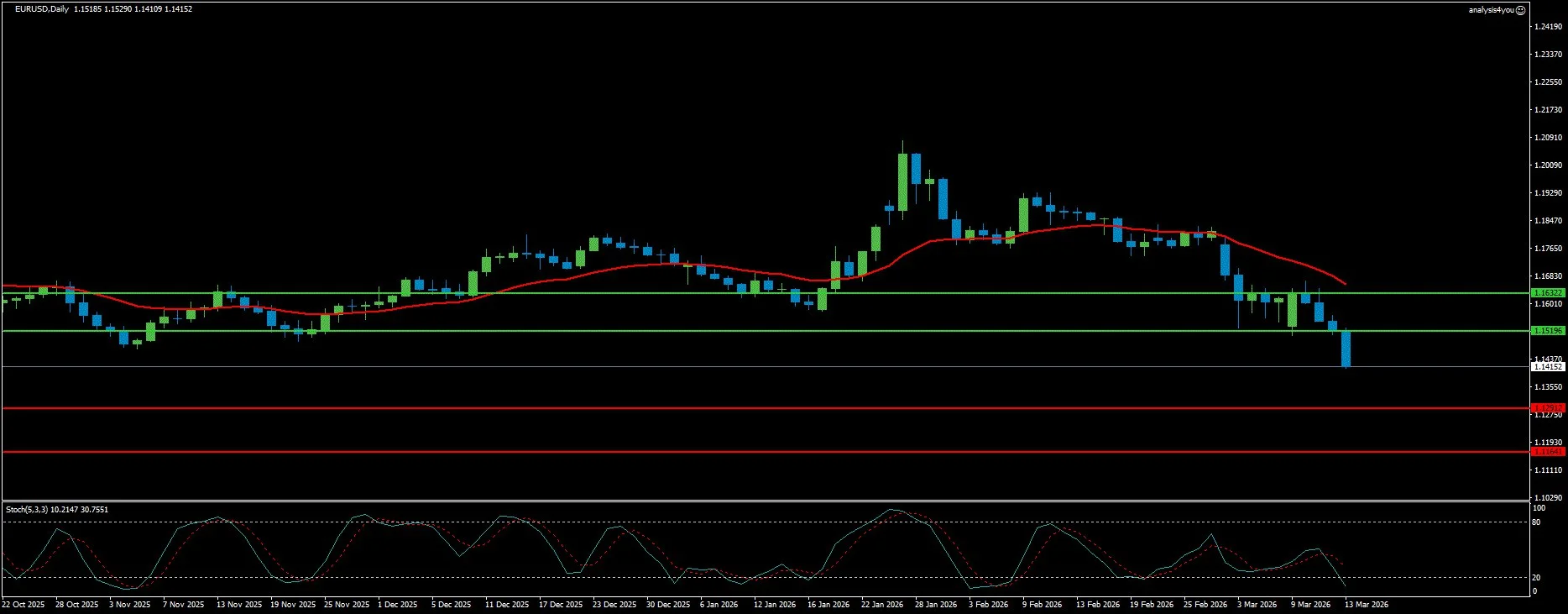
EUR/USD: Tentative Support at 1.1616, ECB Hike Bets Build (1.1616)
Current Trend: Bearish (Oversold Bounce Attempt)
Market Sentiment: Cautious
Resistance: 1.1687 | 1.1775
Support: 1.1543 | 1.1468
EUR/USD stabilized at 1.1616 after last week’s brutal collapse—largest weekly decline in over a year. Found tentative support just above critical 1.1543 as Dollar strength paused Friday. Fundamental backdrop deteriorated dramatically: European February HICP inflation unexpectedly rose to 1.9% (versus 1.7% consensus), PPI jumped 0.7% monthly. Qatar’s LNG halt sent European gas prices surging, and with WTI near $91, European inflation guaranteed to breach ECB’s 2% target. Markets pricing ECB rate hikes before year-end—stunning reversal from Lagarde’s “good place” dovish stance. Q4 GDP revised down to 1.2% (from 1.4%) shows economic deterioration, while inflation approaches target just as 35% oil surge ensures overshoot. “A 20% spike in energy prices is no joke,” analysts warned. Technically, price below all moving averages, 20-day SMA near 1.1800 exhibiting downward traction. RSI in low-30s shows persistent selling without deeply oversold extremes. Weekly chart reveals slide below 20-week SMA around 1.1700—characteristic of first stage sustained bearish trend. Resistance at 1.1687, with 1.1775 needed to ease pressure. Critical support at 1.1543 provides floor—break exposes 1.1468, then 1.1400 and 1.1300.
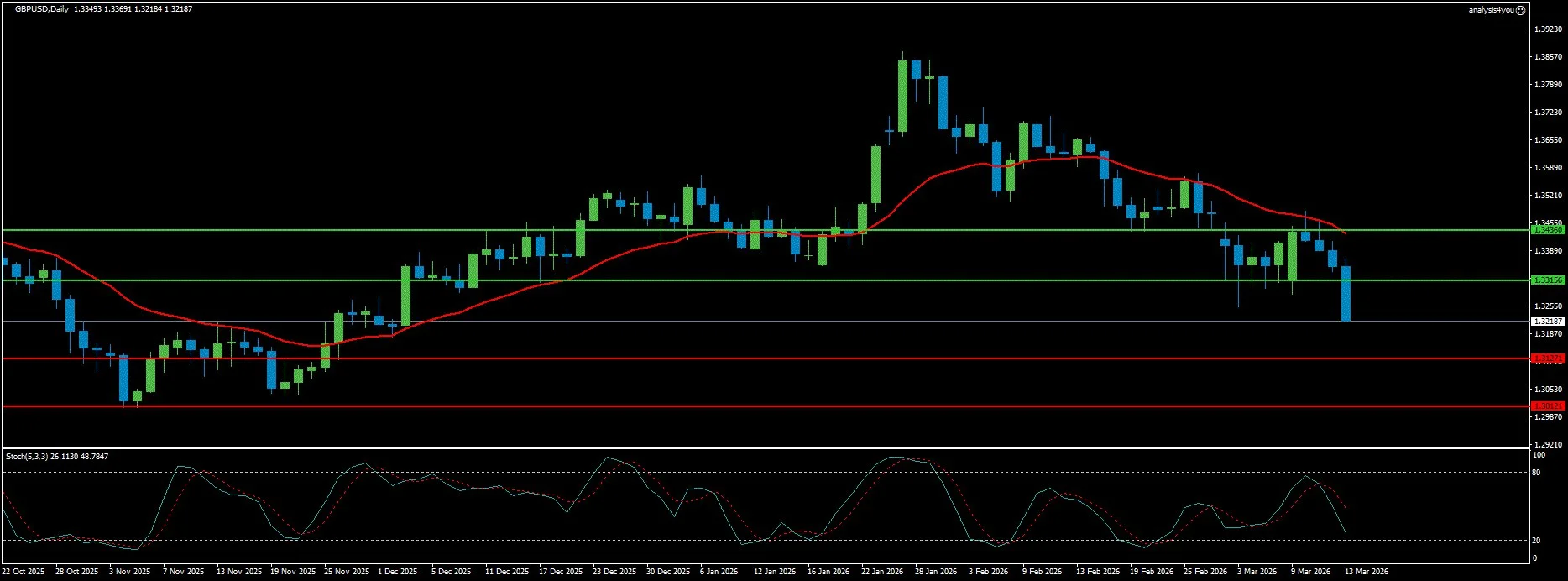
GBP/USD: Clinging to 200-Day SMA Before BoE Decision (1.3406)
Current Trend: Bearish (Defensive)
Market Sentiment: Vulnerable
Resistance: 1.3555 | 1.3694
Support: 1.3249 | 1.3107
Sterling trades at 1.3406, defending critical 200-day SMA around 1.3400 after last week’s plunge to three-month lows near 1.3250. Enters pivotal BoE March 19 meeting in precarious position. Markets widely expect 25bps cut to 4.75%, following shocking dovish 5-4 vote split in February. Bailey signaled “scope for cuts” with “sharp inflation drops expected”—but this narrative clashes with WTI near $91 guaranteeing UK CPI reverses and potentially surges above 3.5-4.0% by summer. Stagflation risk explicit: unemployment at five-year high 5.2%, wages decelerating to 4.2% confirm labor weakness, yet energy inflation threatens to reignite. Tuesday’s UK Budget adds uncertainty, while political drama intensifies after Green Party’s historic Westminster win. Technical positioning shows bearish bias with spot below 21/50-day SMAs while testing 100/200-day cluster around 1.3400. RSI near 34 reinforces bearish momentum without oversold, leaving room for further weakness. Mixed data: unemployment elevated argues for cuts, but retail sales surged 1.8% (largest since May 2024), Composite PMI rose to 53.9 (highest since April). Resistance at 1.3555, extended target 1.3694. Support at 1.3249 must hold to prevent cascade toward 1.3107.
Stocks
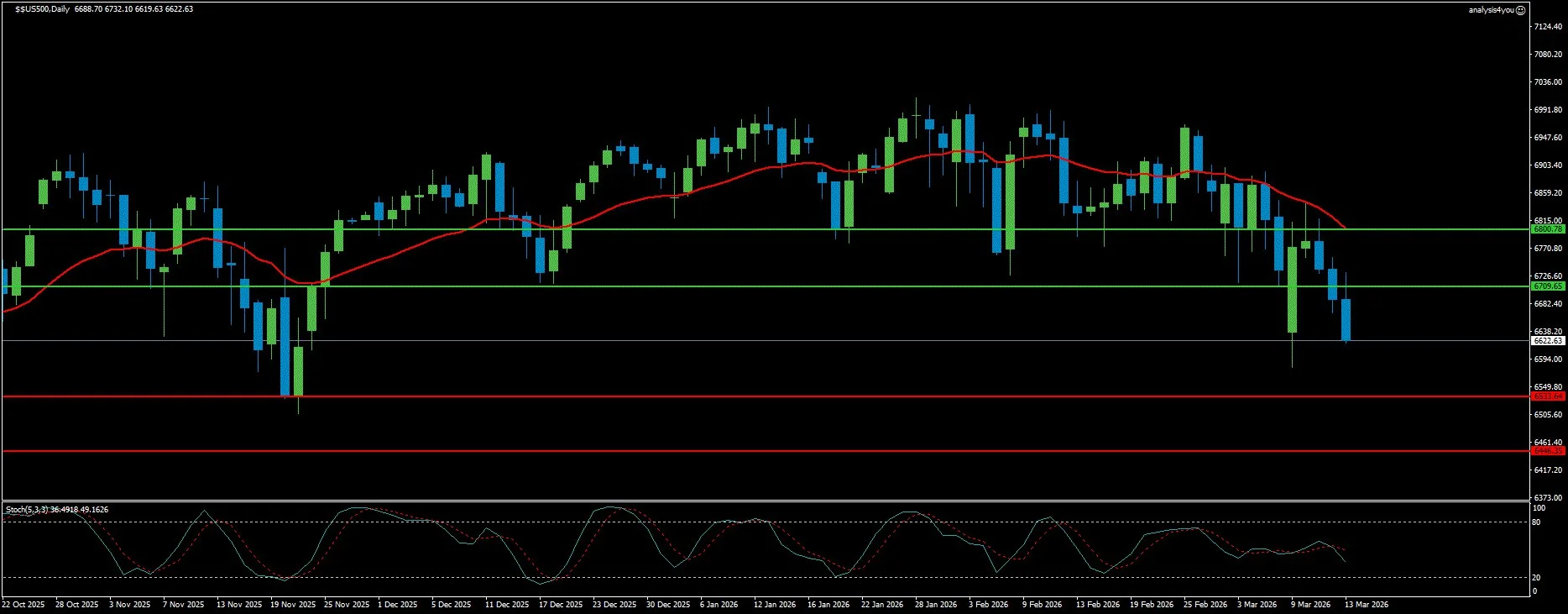
S&P 500: Holding 6,615 Support, But Stagflation Cloud Darkens (6,735)
Current Trend: Range-Bound (Vulnerable)
Market Sentiment: Cautious
Resistance: 6,838 | 6,921
Support: 6,615 | 6,533
The S&P 500 stabilized at 6,735 after last week’s worst performance since October (-2%), successfully testing and holding critical 6,615 support below broken 6,765-6,775 zone. Friday brought modest recovery as war fatigue set in, but index remains trapped in dangerous setup. Wednesday’s CPI shock (2.9% headline versus 2.5%, 3.1% core versus 2.6%) combined with -92K NFP creates explicit stagflation: deteriorating growth alongside reaccelerating inflation. Every $10 oil increase adds 0.3-0.4 percentage points to CPI over 3-6 months—WTI’s $67 to $91 surge will push inflation toward 3.5-4.0% by summer. This eliminates Fed easing and raises hike specter if oil hits $100+. Analysts warn investors too complacent. “Initial reaction to war very tame,” Argent’s Ellerbroek noted. “Investors assume Trump settles for something reasonable.” However, Trump’s “unconditional surrender” rhetoric suggests no quick exit. Defensive rotation intensified—consumer staples, utilities, energy outperforming tech while index hovers less than 4% from highs. This pattern preceded 10%+ corrections in 63% of instances. Currently 63% of stocks outperform index (highest since 2001)—when defensives lead near peaks, corrections typically follow. Defense stocks extended gains (RTX, Lockheed, Northrop up 6-8% from pre-war). CFRA’s Stovall: $100 oil is level “above which investors think we’re heading for worse”—crude at $91 sits just 10% away. Resistance at 6,838 must reclaim to alleviate pressure, 6,921 to confirm correction ended. Break below 6,615 exposes 6,533 and likely cascade toward 6,507 November low.
Commodities
Gold: Dollar Strength Caps Geopolitical Premium (5,175)
Current Trend: Consolidating (Neutral)
Market Sentiment: Mixed
Resistance: 5,420 | 5,600
Support: 4,874 | 4,670
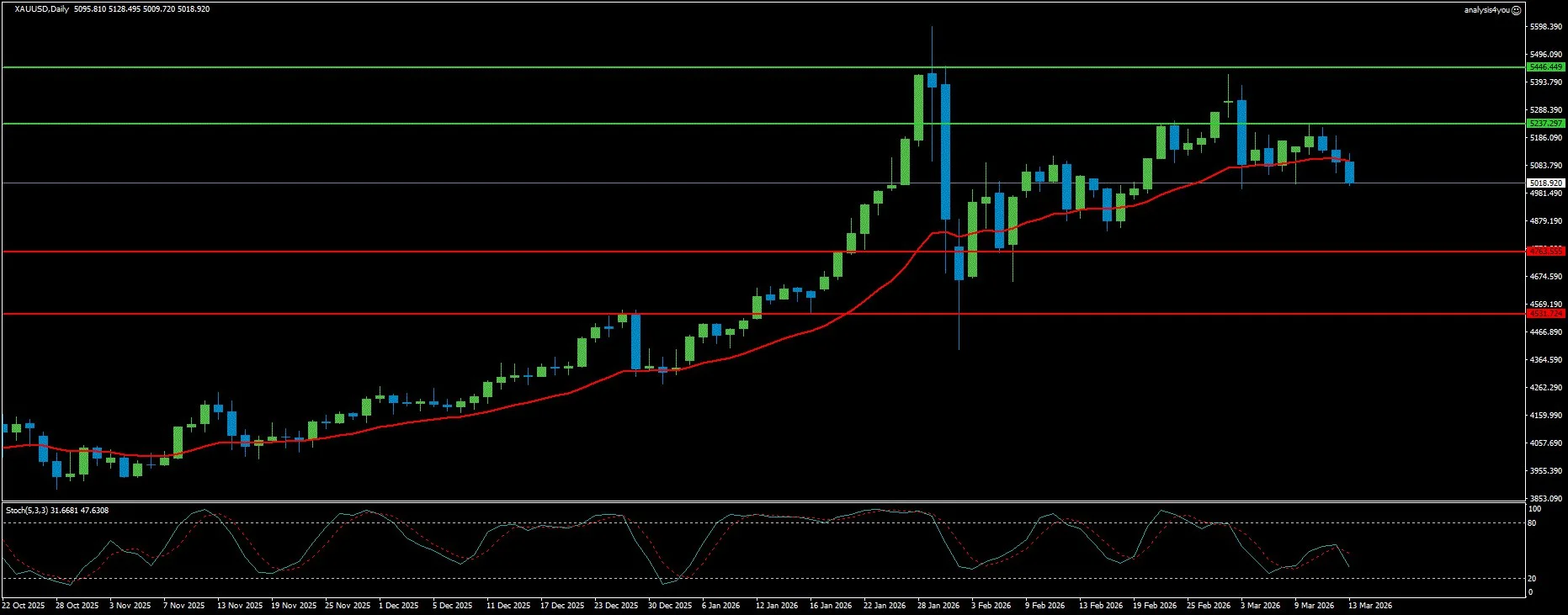
Gold consolidated near $5,175, caught between relentless Dollar strength (briefly above 99.00 Wednesday post-CPI) and genuine geopolitical safe-haven demand from Iran war. Failure to sustain rallies above $5,300 reveals market hierarchy: USD safe-haven flows trump gold geopolitical premiums when both active. Wednesday’s CPI shock (2.9% headline, 3.1% core) strengthened this by raising Fed hawkishness probability—higher real yields pressure non-yielding gold. However, metal refused to break below $5,090-$5,100 support zone (23.6% Fibo, 20-day SMA), suggesting accumulation despite Dollar headwinds. ING’s Manthey: “structural drivers support Gold—geopolitical fragmentation sustains central bank demand.” Central banks net buyers for 14 consecutive quarters, providing $50-70/oz structural premium. Fed outlook critical: if FOMC signals labor concern despite CPI heat, suggests “higher for longer” rather than hikes—less bearish than outright tightening. If Powell emphasizes inflation persistence, gold tests $4,874 decisively. RSI near 50 (neutral), fluctuating around 20-day SMA—classic consolidation before directional breakout. Resistance at 5,420, break opens 5,600 all-time high. Support at 4,874 provides significant protection, 4,670 ultimate floor. Binary: if WTI retreats toward $80s on Hormuz reopening, inflation fears ease and gold rallies; if crude toward $100, stagflation intensifies but persistent Dollar could override.
WTI Crude Oil: Consolidating Near $91 as Navy Escorts Loom (90.91)
Current Trend:
Bullish (Pausing)
Market Sentiment: Cautious
Resistance: 92.62 | 94.18
Support: 89.23 | 87.72
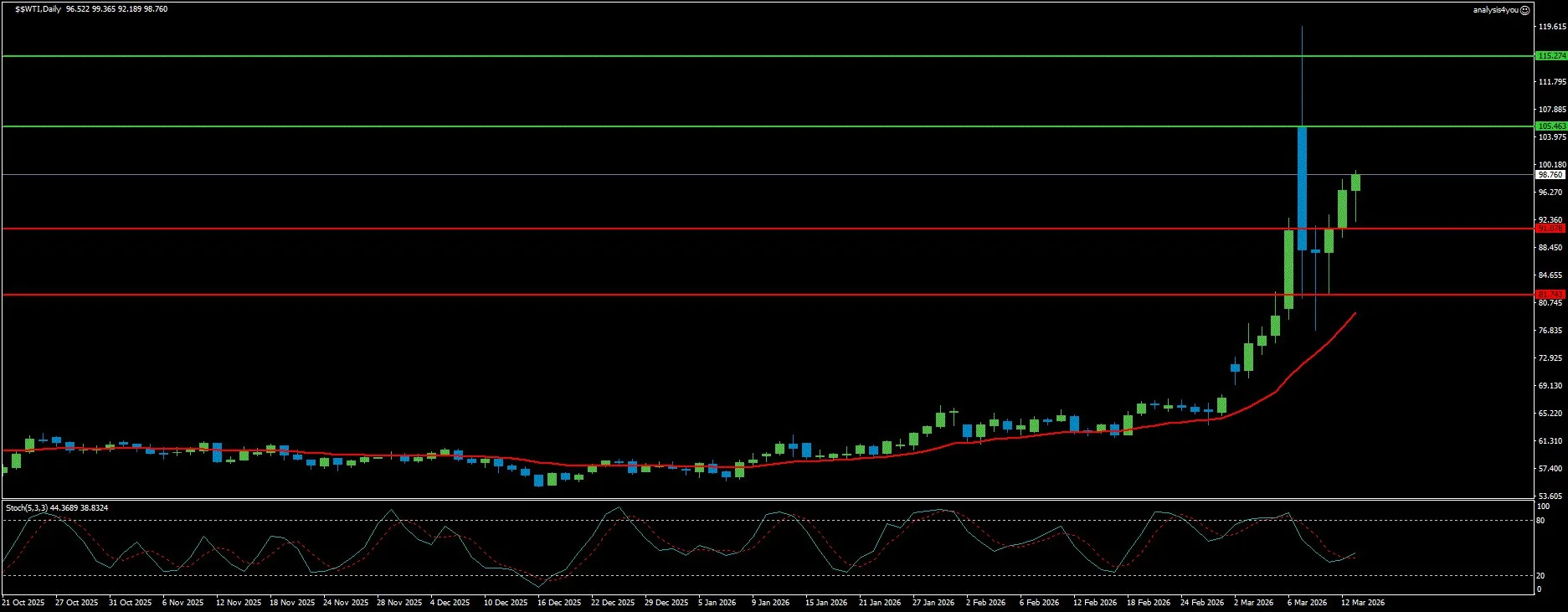
WTI consolidates near $90.91 after last week’s historic 35% surge (biggest since 1983), as markets await US Navy escort operations through Strait of Hormuz. Energy Secretary Wright confirmed Thursday escorts begin “within days,” providing first concrete timeline for addressing supply disruption keeping 150+ tankers anchored and traffic down 70%. Announcement triggered modest profit-taking from $91+ highs, but crude stubbornly elevated as traders assess whether Iran allows escorts unchallenged or escalates. Qatar’s Energy Minister warning of $150 oil if war persists caps downside—his comment that even if war ended immediately, “weeks to months” to normalize deliveries suggests $80+ is new floor. Fundamentals support current levels: Iran’s Guards maintain Hormuz prohibition, at least four vessels attacked near strait. Trump’s “unconditional surrender” with “no time limits” eliminates quick diplomatic hopes. However, if Navy escorts succeed moving tankers safely next week, supply panic could evaporate—analysts estimate crude retreats $10-15 (toward $75-80) within days if normal shipping resumes. Conversely, Iranian attacks on Navy ships or sinking escorted tankers sends oil toward $100-120 as insurance prohibitive. Technical shows daily/weekly extremely overbought after parabolic $67 to $91 rally—consolidation healthy. $85.53 resistance (76.4% Fibo) broken last week now support. Resistance at 92.62, extended 94.18 opening path to $100. Support 89.23, stronger 87.72—break signals supply panic premium evaporating, targets 85.00-85.50. Week is binary: Navy success targets $85-80, Iranian resistance targets $100+.
Crypto
Bitcoin: Fifth Monthly Loss Looms, But $62K Support Intact (67,317)
Current Trend: Range-Bound (Resilient)
Market Sentiment: Cautious
Resistance: 72,670 | 79,396
Support: 62,265 | 56,049
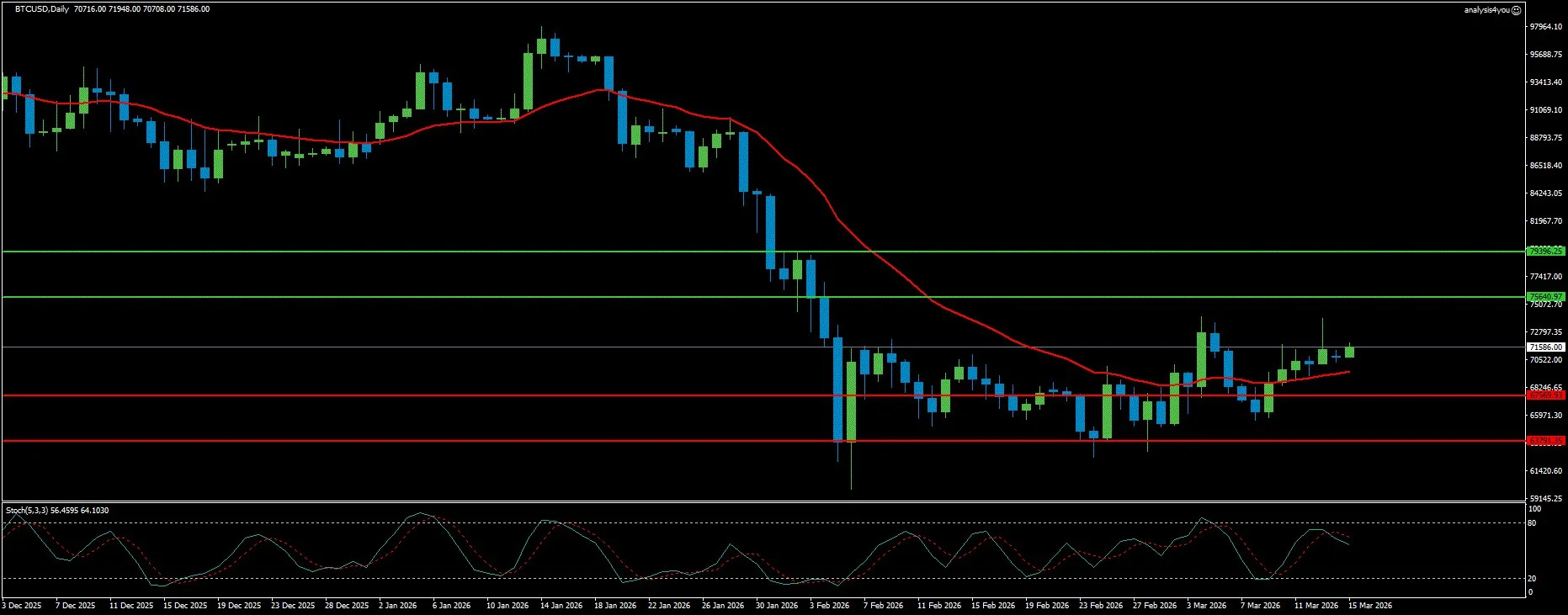
Bitcoin trades at $67,317, demonstrating surprising resilience through two weeks of Iran war, $91 oil, and stagflation-inducing CPI that traditionally crush risk assets. On track for fifth consecutive monthly loss—longest streak since August-December 2018 bear—with March -3.5% month-to-date after February’s -14.51% and January’s -10.17%. Three consecutive monthly declines historically seen only during severe bears (2014, 2018, 2022). Yet BTC successfully held above critical $62,265 support—make-or-break threshold below which capitulation risk accelerates. Week brought conflicting signals: spot ETF inflows resumed with $340M Monday-Tuesday, but Wednesday’s CPI shock triggered $156M outflow. Net weekly inflow ~$184M—positive but below $1.14B three-day surge during war’s first week. Strategy purchased just 485 BTC (total 718,207 at $76,065 average), continuing reduced pace from historical 10K+ weekly purchases. Jane Street lawsuit creates overhang—alleged insider trading on UST/LUNA. Arkham spotted $12M BTC deposited to institutional exchanges from Jane Street-linked wallets, raising forced selling concerns. Macro backdrop presents headwinds: Fed study shows every $10 oil adds 20 basis points to CPI—crude’s $67 to $91 surge implies 48 bps additional inflation over 3-6 months. If this keeps Fed at 4.25-4.50% or triggers hikes at $100 oil, Bitcoin struggles above $75K resistance. However, Waller noted impact “may not affect decision if unwinds in weeks,” leaving door open for easing. CryptoQuant: market “suggests deleveraging and cooling, but not bottom.” CME futures curve slope trending lower mirroring pre-2018/2021 bears. Curve remains in contango rather than backwardation characterizing historical bottoms. Monthly realized losses just 0.38M BTC versus 1.1M at 2022 bottom—incomplete capitulation. MVRV at 1.85, well above sub-1.0 extreme undervalued zone where previous lows formed (0.75 in 2018, 0.82 in 2022). Analysts predict “$55K ultimate bear bottom” with realized price 18% below current. Previous bears saw BTC cross below realized by 24% (2022 FTX) and 30% (2018)—suggesting further downside may flush weak hands. Technical shows BTC consolidating $65,729-$74,000 range, defending $62,265 critical support on multiple tests. Daily RSI recovered to 45 from sub-30 oversold, indicating fading bearish momentum without bullish reversal (needs sustained above 50). Weekly RSI at 29 (oversold but stabilizing). MACD maintains bullish crossover but shallow histogram shows weak momentum. Resistance at 72,670 must clear decisively to alleviate pressure, breakout targets extended 79,396. Break below 62,265 exposes 56,049 capitulation zone near $55K ultimate bottom. Most probable scenario: range-bound $65K-$74K consolidation. Asymmetric risk slightly favors downside—$62,265 sits 7.5% below, $72,670 stands 8% above, but breaking support (cascade to $56K) more severe than failing resistance. However, resilience holding $62K through maximum stress suggests institutional maturation building genuine base in $62K-$75K zone.
Key Events This Week (March 16-20, 2026)
Geopolitical
- US Navy Hormuz escorts begin “within days”—peaceful passage or Iranian attacks?
- Oil at $91: $100 if escorts fail, $80s if succeed
- Trump maintains “unconditional surrender” rhetoric
Central Banks
- Tuesday: UK Budget announcement
- Wednesday: FOMC Decision (hold at 4.25–4.50% expected)—Powell’s inflation vs labor emphasis critical
- Thursday: BoE Decision—25bps cut to 4.75% widely expected despite stagflation concerns
Economic Data
- Tuesday: US Housing Starts, Building Permits
- Wednesday: US Existing Home Sales
- Thursday: US Jobless Claims, Philly Fed Manufacturing
- Friday: US Retail Sales (January, delayed)
Other
- Fed blackout began Saturday (no speakers until post-FOMC)
- Defense stocks up 6–8% since war began
- S&P 500 defensive rotation at 63% participation (highest since 2001)
Week Ahead Outlook
The week delivers the most consequential central bank decisions since the Iran war began, with Wednesday’s FOMC and Thursday’s BoE both navigating impossible stagflation dilemma: deteriorating labor (US -92K NFP, UK 5.2% unemployment) versus reaccelerating inflation (US CPI 2.9%, UK energy shock). Powell faces acute tension—acknowledge 3.1% core CPI risking hawkish repricing crushing equities and strengthening Dollar toward 100.01, or emphasize labor weakness undermining inflation-fighting credibility. Most likely path: cautious neutrality acknowledging both risks, maintaining “data dependent,” avoiding June cut commitment while keeping door open. Mildly Dollar-supportive (holds 98.64-99.47 range) but insufficient to break 99.47 without additional catalysts.
Thursday’s BoE decision carries equal drama. Markets price 25bps cut with 85% probability, but committee faces brutal optics: cutting as oil’s 35% surge guarantees UK inflation reverses toward 4% by summer. February’s 5-4 dovish split showed four members wanted immediate cuts expecting “sharp inflation drops”—narrative clashes with $91 oil reality. If cut proceeds, Sterling tests 1.3249 decisively, potentially breaking toward 1.3107. Any dovish dissent (6-3 or 7-2) or hawkish guidance citing oil risks could trigger short-covering toward 1.3555.
Geopolitical binary remains paramount. Navy escort success or Iranian resistance. Wright’s “within days” suggests operations Monday-Tuesday. If convoys transit safely without attacks, supply panic evaporates—WTI retreats $8-12 toward $82-87 within 48 hours as 150+ tankers resume. This scenario: Dollar-negative (removes stagflation premium), equity-positive (S&P 500 toward 6,838-6,921), crypto-positive (Bitcoin tests 72,670). Conversely, Iranian attacks, mining, or sinking escorted tankers sends WTI toward $100-110—strengthens Dollar toward 100.01-101.50, crashes equities through 6,615 toward 6,533, pressures Bitcoin toward 62,265.
Friday’s delayed January Retail Sales provides final labor deterioration piece. December stalled at -0.1%, weak November prior. If January confirms consumer pullback (consensus 0.2-0.3% gain), validates recession risk -92K NFP began. Retail weakness combined with 4.4% unemployment and 3.1% core CPI creates textbook stagflation equities fear most.
Positioning: Long USD cautiously toward 99.47, stops 97.82. EUR/USD and GBP/USD vulnerable—shorts below 1.1616 and 1.3406. S&P 500 tactical short below 6,735 targeting 6,615. WTI binary—avoid or small longs wide stops. Gold range-bound, avoid. Bitcoin hold above 62,265, consider adding if Hormuz reopens.
Iran war enters week three with Navy escorts providing first concrete catalyst. Wednesday FOMC and Thursday BoE navigate stagflation with no good answers. Markets positioned for “muddle through,” but binary risks suggest volatility expands. Risk management paramount—reduced sizes, tight stops, prepared for gaps.


