Warsh Nomination Sparks Dollar Rally: Gold Crashes from $5,600, Bitcoin Nears $80K

Market Sentiment Overview
Markets experienced whiplash volatility as Trump’s nomination of hawkish Kevin Warsh to replace Powell triggered a sharp Dollar rebound from four-year lows. The Greenback surged from 95.50 to 96.83 after collapsing to levels last seen in February 2022, while Gold suffered brutal profit-taking from record highs above $5,600 to settle near $4,885—a correction exceeding $700. Bitcoin’s collapse accelerated to $78,528, nearing November lows at $80,000, with weekly losses approaching 6% amid $978 million in ETF outflows and Fed hawkishness. The S&P 500 briefly touched the psychological 7,000 level Wednesday before pulling back to 6,932, while Microsoft’s $400 billion post-earnings wipeout shocked markets. EUR/USD retreated from multi-year highs at 1.2082 to 1.1853, and GBP/USD pulled back from four-year peaks at 1.3870 to 1.3682 despite forming a Golden Cross. The week ahead features the Bank of England’s “Super Thursday” decision and Friday’s critical US Nonfarm Payrolls report.
Currencies
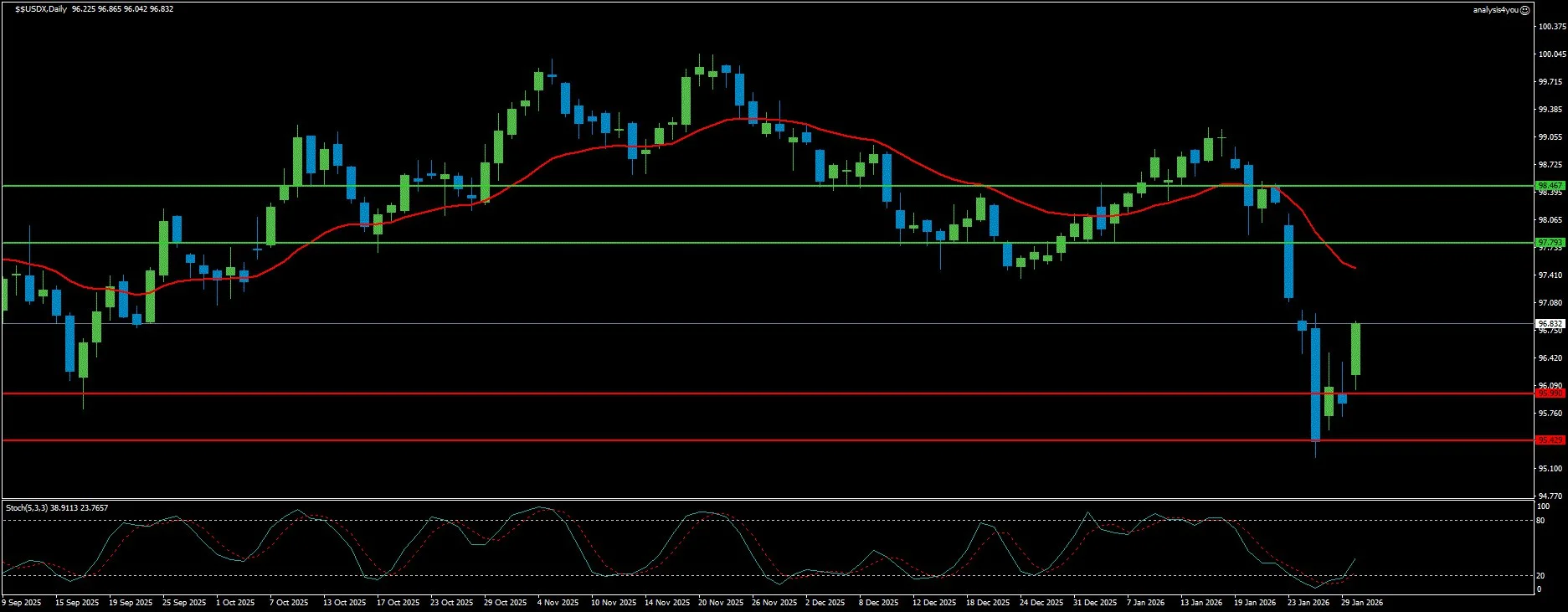
USD Index: Warsh Rally From Four-Year Lows (96.83)
Current Trend: Recovering/Volatile Market Sentiment: Mixed
The US Dollar Index experienced extreme volatility, plunging to 95.50 (February 2022 lows) before staging a powerful recovery to 96.83 following Trump’s Friday nomination of hawkish former Fed Governor Kevin Warsh as Powell’s successor. The week began disastrously for the Dollar as speculation mounted that the US conducted a “rate check” on USD/JPY—contacting banks about positions ahead of potential intervention. Trump then poured gasoline on the fire Tuesday, saying the Dollar’s decline was “great” when asked about its weakness, sending the Greenback to four-year lows. Treasury Secretary Bessent scrambled to contain damage Wednesday, reaffirming Washington’s “strong dollar policy” and denying any Japanese intervention plans. The Fed held rates unchanged at 3.50%-3.75% as expected, with Powell’s press conference disappointing investors by avoiding political questions and providing little dovish guidance despite solid growth and “clear improvement” in the economic outlook. The Warsh nomination Friday immediately triggered Dollar weakness as markets processed the hawkish implications, but profit-taking ahead of month-end and government shutdown avoidance deal helped the Greenback recover. Critical support at 95.99 now underpins the recovery, with resistance at 97.79 required to confirm the reversal from four-year lows.
Resistance: 97.79 | 98.47
Support: 95.99 | 95.43
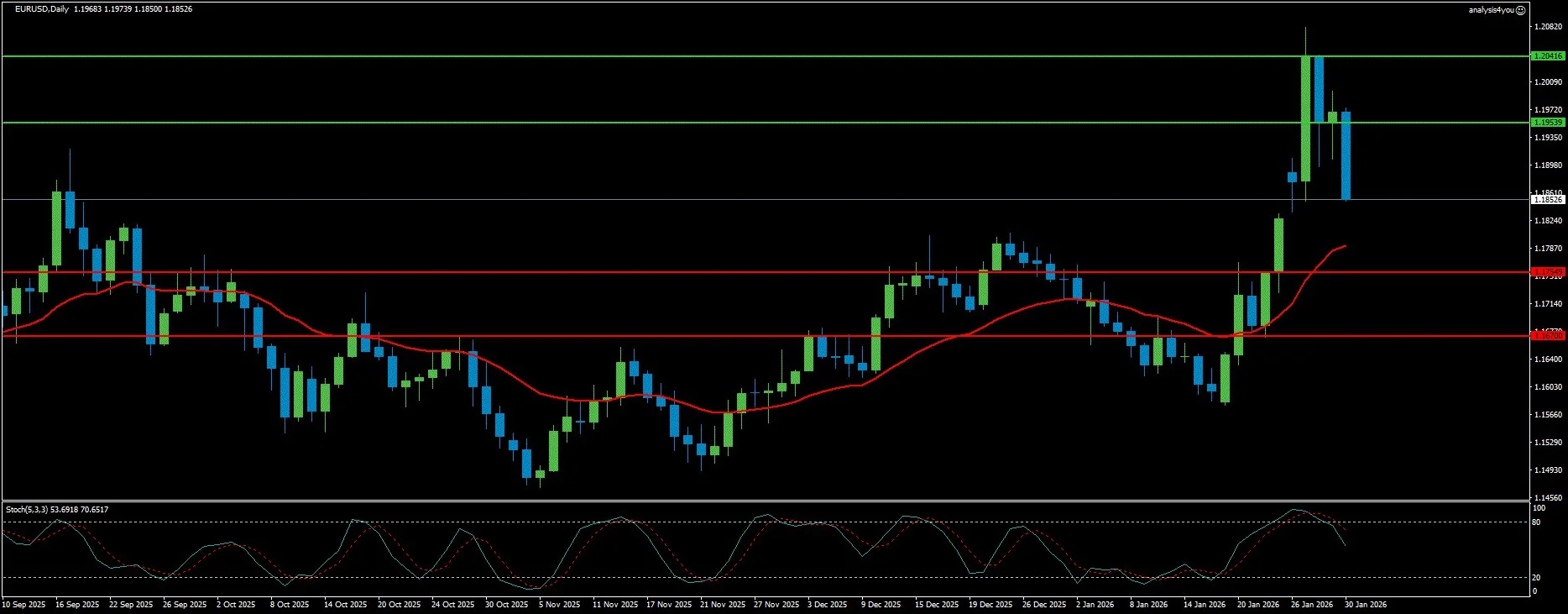
EUR/USD: Sharp Retreat From 1.2082 Multi-Year High (1.1853)
Current Trend: Corrective (Still Bullish Medium-Term) Market Sentiment: Cautious
EUR/USD soared to a multi-year high of 1.2082 early week before suffering a sharp reversal to settle near 1.1853 as Dollar weakness reversed on Warsh nomination and month-end profit-taking. The pair gapped lower Monday on Japan intervention speculation, then rallied aggressively on Trump’s “Dollar decline is great” comments before finally reversing course as Bessent reaffirmed strong Dollar policy and the Warsh hawk was named Fed Chair successor. European data showed encouraging signs of recovery—Q4 GDP expanded 0.3% (1.4% annualized), Germany’s Q4 GDP grew 0.3% quarterly (0.4% YoY), and GfK Consumer Confidence improved to -24.1 from -26.9. Politically, the EU demonstrated defiance of Trump’s tariff threats by signing major trade deals with India (after two decades of negotiations) and South America’s Mercosur bloc, signaling determination to reduce dependence on US trade relationships. Despite the pullback, the pair remains above all moving averages with support at 1.1755 and 1.1670, while resistance at 1.1954 must be cleared to challenge the recent 1.2082 peak again.
Resistance: 1.1954 | 1.2042
Support: 1.1755 | 1.1670
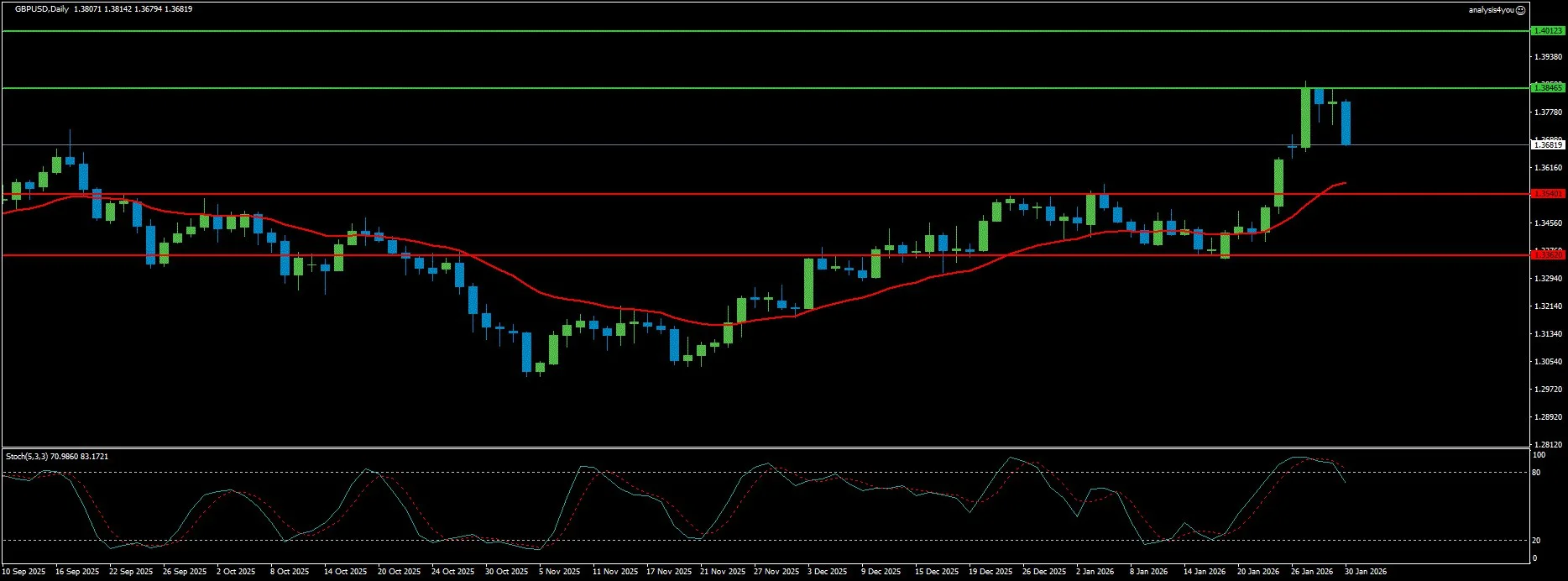
GBP/USD: Golden Cross Forms Despite Pullback From 1.3870 (1.3682)
Current Trend: Bullish (Correcting) Market Sentiment: Positive Medium-Term
GBP/USD accelerated to four-year highs near 1.3870 on relentless Dollar selling before experiencing a late-week pullback to 1.3682 as the Greenback found footing. The pair benefited enormously from Dollar meltdown driven by Trump’s “Dollar decline is great” comments and Fed independence concerns. Technically significant, the 50-day SMA crossed above the 200-day SMA during the week, validating a Golden Cross that reinforces bullish conviction for further upside ahead. US Conference Board Consumer Confidence crashed to 84.5—the lowest in 11.5 years—adding to Dollar headwinds, while geopolitical tensions from Russia-Ukraine Abu Dhabi peace talks ending without agreement (Russia demanding all of Donbas) and Trump’s 100% tariff threat on Canada if it pursues China trade deal maintained risk-off flows favoring Sterling. The pullback found support well above the 21-day SMA at 1.3533, with immediate resistance at 1.3846 and extended targets at 1.4012 if the Golden Cross pattern plays out.
Resistance: 1.3846 | 1.4012
Support: 1.3540 | 1.3362
Stocks
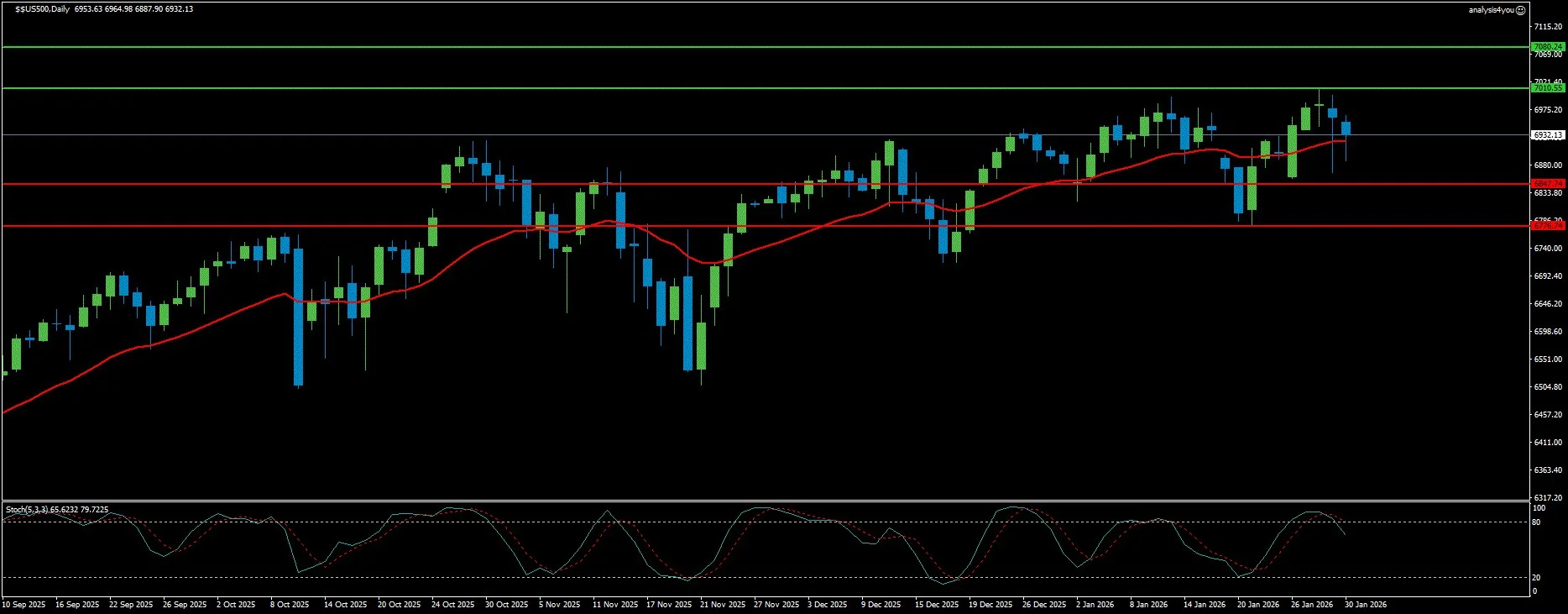
S&P 500: 7,000 Touched, Then Retreated (6,932)
Current Trend: Fatigued/Consolidating Market Sentiment: Cautious
The S&P 500 achieved the psychological 7,000 milestone Wednesday morning ahead of the Fed decision, prompting a congratulatory tweet from Trump before prices immediately began pulling back. Thursday threatened a larger correction, but bulls responded forcefully before Friday saw another sizable pullback that pared gains into the close. The index settled at 6,932, displaying “clear fatigue” despite little reason for outright bearishness given Trump’s persistent market pumping and the Fed’s apparent unwillingness to stand in the way. However, the Russell 2000 is becoming the year’s star performer, gaining ground on expectations that Trump’s “Big Beautiful Bill” and fiscal stimulus ahead of midterm elections will broaden the rally beyond mega-cap tech. The S&P’s extreme concentration (41 AI stocks = 47% of value) creates vulnerability if tech leaders stumble, evidenced by Microsoft’s Thursday disaster.
Resistance: 7,010 | 7,080
Support: 6,847 | 6,776
Commodities
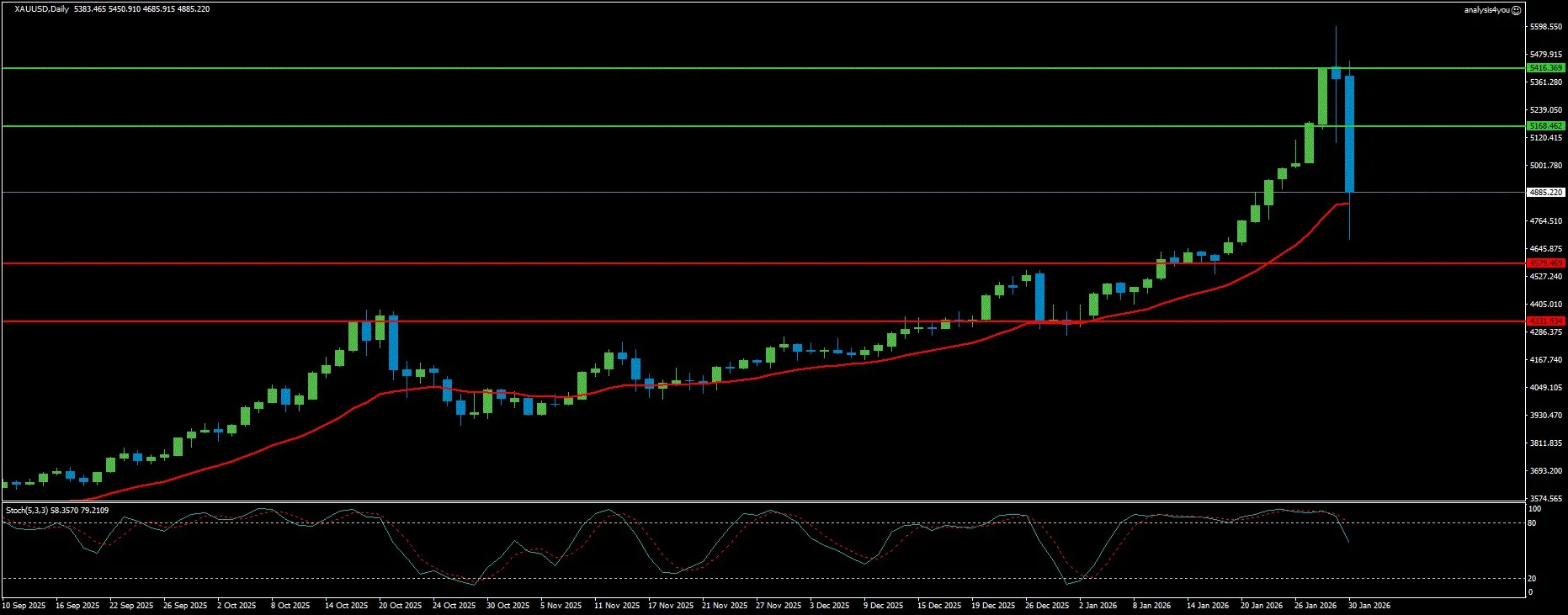
Gold: Brutal $700+ Correction From $5,600 Record (4,885)
Current Trend: Sharp Correction (Bull Trend Intact) Market Sentiment: Profit-Taking
Gold suffered its most severe correction in months, plunging over $700 from Thursday’s record high above $5,600 to settle near $4,885 Friday. The precious metal briefly reached $5,598 Thursday before violent profit-taking amid broad-based commodity selling, firmer Dollar on Warsh nomination, and mixed US Treasury yields. Despite the brutal pullback, Gold clinched its fourth consecutive week of gains and remains up over 16% year-to-date, with analysts viewing the correction as temporary and healthy after the parabolic rally. Technical analysis shows declining open interest even as prices hit records, indicating the recent surge was driven primarily by position-closing and profit-taking rather than new buying—a classic exhaustion signal. Support at 4,579 should hold on further weakness, with stronger support at 4,331. Analysts continue to eye the $6,000 level as the next major target once consolidation completes, driven by Fed rate cut expectations, geopolitical tensions (US-Iran military buildup), and Warsh’s perceived dovish leanings despite his hawk reputation.
Resistance: 5,168 | 5,416
Support: 4,579 | 4,331
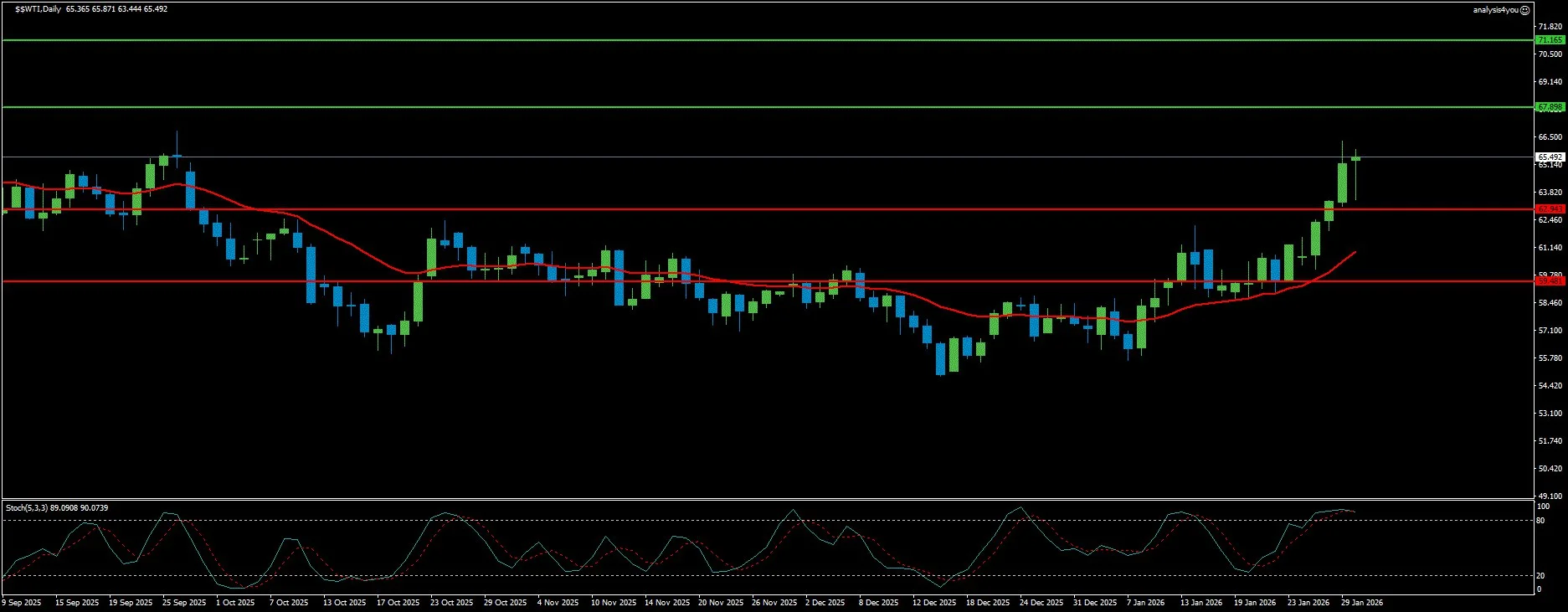
WTI Crude Oil: Iran Dialogue Hopes Sink Prices (65.49)
Current Trend: Correcting Market Sentiment: Easing Tensions
WTI crude fell Friday to 65.49 (from Thursday’s high near 69.61 for Brent) amid signs the US may open dialogue with Iran over its nuclear program, easing concerns about supply disruptions from military action. Trump urged Iran Wednesday to “make a deal on nuclear weapons or face an attack” but pivoted Thursday to say he’s “planning to speak to the country’s leaders.” Tehran responded defiantly, warning it would “strike back hard.” Despite the Friday pullback, both benchmarks posted their first monthly gains in six months—Brent up 14.5% (biggest jump since January 2022) and WTI up 12% (largest monthly gain since July 2023)—driven by US military buildup in the region (USS Abraham Lincoln carrier group plus guided-missile destroyers) and production disruptions in Kazakhstan, Russia, and Venezuela totaling 1.5 million bpd. Kazakhstan is restarting the Tengiz oilfield after electrical fires, while US Arctic weather cut 340,000 bpd. Current price at 65.49 sits well above critical support at 62.94, with resistance at 67.90 required to resume the rally.
Resistance: 67.90 | 71.16
Support: 62.94 | 59.48
Crypto
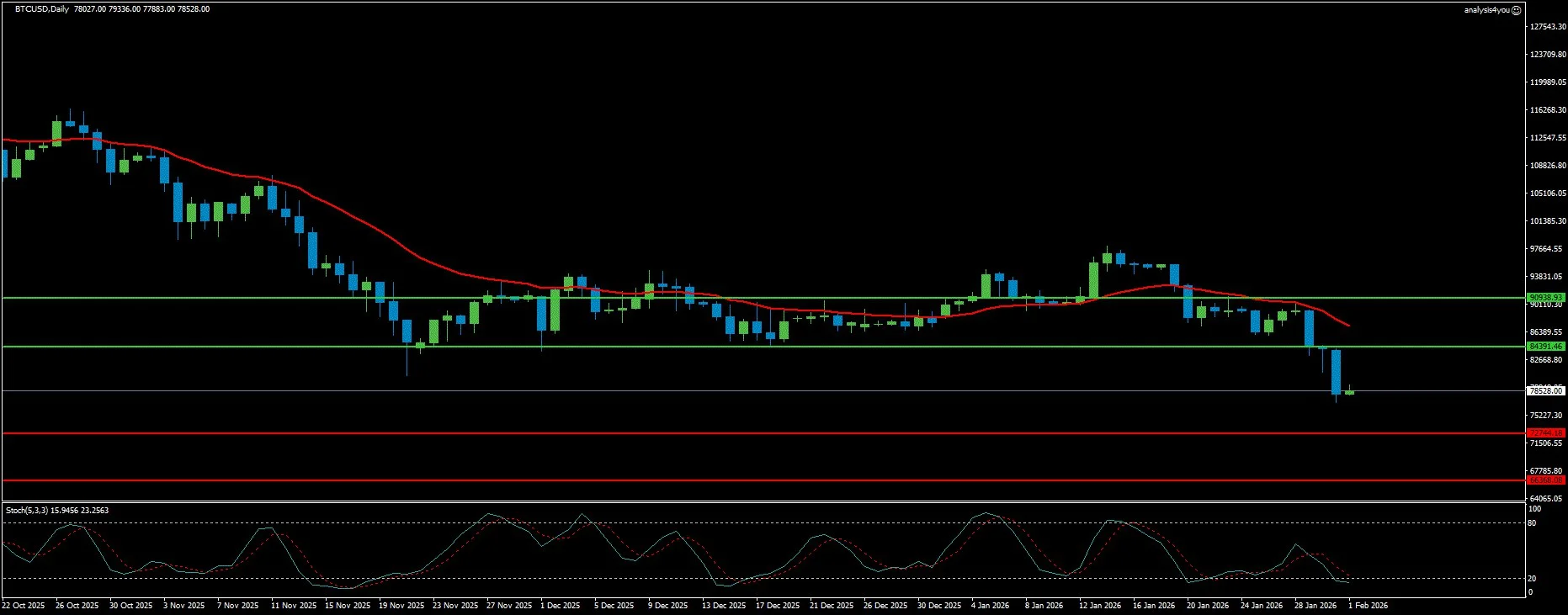
Bitcoin: Collapse Accelerates Toward $80K November Lows (78,528)
Current Trend: Severely Bearish Market Sentiment: Extremely Negative
Bitcoin’s correction deepened dramatically, plunging below $82,000 to $78,528 and posting weekly losses approaching 6% as multiple bearish catalysts converged. Institutional demand evaporated with spot ETFs recording $978 million in outflows through Thursday—the second consecutive weekly withdrawal with Thursday’s $817.87 million representing the largest single-day outflow since November 21. Friday saw $1.87 billion in total market liquidations, with over 90% being long positions, underscoring extreme bullish positioning being violently unwound. The Fed’s lack of dovish guidance, Powell’s emphasis that inflation remains “well above the 2% target,” and Warsh’s hawkish nomination all weighed heavily on risk assets. Geopolitical tensions intensified with Trump weighing targeted strikes on Iranian security forces and leaders, triggering risk-off sentiment favoring Gold/Silver over crypto. Critically, US winter storms disrupted Bitcoin mining operations, causing a 12% hashrate drawdown to 970 EH/s (lowest since September 2025) and daily mining revenue collapsing from $45 million to $28 million—the lowest of the year. Miner stress is evident in positive netflow readings, indicating increased BTC transfers to exchanges for potential selling. Bitcoin now trades dangerously close to Strategy’s average buying price of $76,037 (firm holds 712,647 BTC), a key psychological support level. Critical support at 72,744 looms, with a break exposing 66,368 and potentially the November lows near $80,600. Recovery requires a decisive break above 84,391 resistance.
Resistance: 84,391 | 90,938
Support: 72,744 | 66,368
Key Events This Week (February 2-6, 2026)
Major Central Bank Decisions
-
Thursday: Bank of England “Super Thursday” – Rate decision followed by Governor Bailey’s press conference providing insights on interest rate path
-
High volatility expected for GBP/USD on BoE announcements and updated economic forecasts
Critical US Employment Week
-
Monday: ISM Manufacturing PMI (January) – Expected 48.3 (still contraction)
-
Tuesday: JOLTS Job Openings (December)
-
Wednesday: ADP Employment Change (January), ISM Services PMI (January)
-
Friday: US Nonfarm Payrolls (January) – Week’s main event alongside Unemployment Rate
-
Friday: University of Michigan Consumer Sentiment (February preliminary)
Eurozone & UK Data
-
Tuesday: Eurozone HICP (final, December)
-
Thursday: ECB decision on monetary policy – Expected hold, focus on Lagarde press conference (limited impact expected)
-
Friday: UK data releases
Geopolitical Flashpoints
-
Iran Tensions: Trump weighing targeted strikes on security forces/leaders; separate talks with Israel and Saudi defense officials in Washington on Iran strategy
-
US Military Posture: Carrier group and destroyers in Middle East, 70% probability (Citi) of “restrained actions” including tanker seizures vs 30% risk of broader military strike
-
Canada Tariffs: Trump threatened 100% tariffs if Canada pursues China trade deal
-
Russia-Ukraine: Peace talks ended without agreement; Russia demanding all of Donbas
Market Structure Themes
-
Russell 2000 Leadership: Small-caps outperforming on fiscal stimulus expectations and broadening rally narrative
-
Tech Concentration Risk: Microsoft’s $400B loss highlights vulnerability; Nasdaq lagging since October 29
-
Fed Independence: Criminal investigation of Powell, efforts to remove Governor Lisa
Week Ahead Outlook
Friday’s Nonfarm Payrolls report dominates the calendar and will be critical for determining whether the Fed maintains its patient stance or if labor market weakness forces a dovish pivot. With Warsh’s nomination signaling potential hawkishness, strong employment data would reinforce the “higher for longer” narrative and support the Dollar’s recovery from 95.50 lows. Conversely, weak data could reignite overall selling despite Warsh’s appointment, particularly if unemployment rises unexpectedly.
The Dollar’s position at 96.83 represents a critical juncture. Recovery from four-year lows requires breaking above 97.79 resistance to target 98.47 and potentially recover the broken 200-day SMA that has capped rallies since late January. However, Trump’s stated preference for Dollar weakness (“I think it’s great”) creates a political headwind that could resurface any time, making 95.99 support crucial—a break would expose 95.43 and potentially revisit the 95.50 lows.
EUR/USD’s pullback to 1.1853 from 1.2082 looks corrective rather than reversal, with support at 1.1755 and 1.1670 expected to hold barring unexpectedly hawkish ECB commentary Thursday. The EU’s trade deals with India and Mercosur demonstrate strategic defiance of Trump’s tariff threats and commitment to reducing US trade dependence—a structural support for the Euro medium-term. Resistance at 1.1954 must be cleared to resume the assault on 1.2042 and the recent peak.
GBP/USD’s Golden Cross at 1.3682 is technically significant and historically reliable as a bullish signal. Thursday’s BoE decision will be critical—any hints of faster rate cuts would pressure Sterling toward 1.3540 support, while a hawkish hold would target 1.3846 resistance and potentially 1.4012. The four-year highs at 1.3870 remain within reach if Dollar weakness resumes.
Gold’s $700 correction from $5,600 to $4,885 represents healthy profit-taking after a parabolic rally. Support at 4,579 should hold barring a complete collapse in geopolitical tensions, with 4,331 as stronger support. The combination of Fed rate cut expectations (despite Warsh hawkishness), Middle East military tensions (Trump weighing Iran strikes), Dollar structural concerns, and open interest patterns suggesting exhaustion of profit-taking all support a resumption of the bull trend toward $6,000 once consolidation completes. Resistance at 5,168 and 5,416 will be tested on the next leg higher.
Bitcoin’s collapse to 78,528 is entering critical territory near Strategy’s $76,037 average price and the November lows at $80,600. Support at 72,744 represents a make-or-break level—a breach would expose 66,368 and signal a deeper crypto winter. The combination of $978M ETF outflows, $1.87B liquidations (90% longs), mining disruption (12% hashrate decline), miner stress (positive netflows to exchanges), Fed hawkishness, and geopolitical risk-off all paint an extremely bearish picture. Positive catalysts include Fidelity’s FIDD stablecoin launch, CFTC/SEC “Project Crypto” collaboration, and Trump’s promise to “sign all on crypto soon,” but these longer-term positives are overwhelmed by immediate bearish technicals. Recovery requires reclaiming 84,391 resistance decisively.
The S&P 500’s fatigue at 6,932 after touching 7,000 suggests consolidation ahead of a potential push higher. Support at 6,847 and 6,776 should hold given Trump’s market-pumping incentives ahead of midterm elections and the Fed’s patient stance. However, Microsoft’s $400B wipeout and the Nasdaq’s October 29 all-time high divergence from S&P/Russell 2000 highlight concentration risks. The Russell 2000’s leadership reflects broadening rally expectations from fiscal stimulus, which would be healthy for overall market structure if sustained.
Oil’s pullback to 65.49 on Iran dialogue hopes feels premature given the military buildup (carrier group in region) and Trump’s track record of mixed signals. Support at 62.94 should hold, with a break toward 59.48 only likely if genuine diplomatic breakthrough emerges. Resistance at 67.90 and 71.16 will be tested if Iran tensions reignite or if Kazakhstan/Russia/Venezuela disruptions persist. The 14.5% monthly gain in Brent suggests substantial geopolitical premium remains embedded despite Friday’s pullback.
Iran represents the week’s biggest wildcard. Trump hosting separate talks with Israeli and Saudi officials while weighing targeted strikes creates hair-trigger conditions for escalation. Citi’s 70% probability of “restrained actions” (tanker seizures) versus 30% risk of broader strikes captures the uncertainty. Any actual military action would send Gold through $6,000, Oil toward $90-110, and trigger severe equity corrections below 6,776 support.
Risk management is absolutely critical. The combination of Warsh nomination uncertainty, NFP data Friday, BoE Thursday, Iran military tensions, Bitcoin’s proximity to $80K November lows, and Gold’s $700 correction all create extreme volatility potential. The Dollar’s recovery from four-year lows at 95.50 to 96.83 could easily reverse on weak NFP or renewed Trump Dollar-weakness comments, while strong data would accelerate the rally toward 98.47.


